










Breaking News
 The Smartest Dog
  Why Florida's Financial Pressure Is a National Signal
 US Unveils First Autonomous Microwave Weapon Robot to Defeat Drone Swarms in Seconds...
 Japan Breaks Internet Speed Record with 5 Million Times Faster Data Transfer
Top Tech News
 Build a Greenhouse HEATER that Lasts 10-15 DAYS!
 Look at the genius idea he came up with using this tank that nobody wanted
 Latest Comet 3I Atlas Anomolies Like the Impossible 600,000 Mile Long Sunward Tail
 Tesla Just Opened Its Biggest Supercharger Station Ever--And It's Powered By Solar And Batteries
 Your body already knows how to regrow limbs. We just haven't figured out how to turn it on yet.
 We've wiretapped the gut-brain hotline to decode signals driving disease
 3D-printable concrete alternative hardens in three days, not four weeks
 Could satellite-beaming planes and airships make SpaceX's Starlink obsolete?
 First totally synthetic human brain model has been realized
 Mach-23 potato gun to shoot satellites into space


General Flynn: Strategic Assessment Of Marxist-Style Color Revolution Targeting America
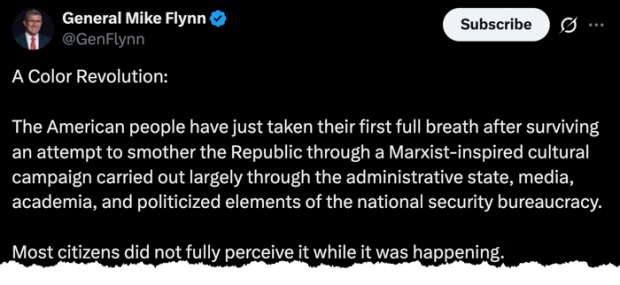
Most citizens did not fully perceive it while it was happening. Many in the intelligence community either passively accepted it or actively furthered it. The architects of this project are not finished, but their effort has been damaged and delayed. It is only by the grace of God that the country has endured to this point.
The American version of the cultural revolution is distinct from the Maoist model that ravaged China in the twentieth century. It did not coalesce around a single charismatic revolutionary figure. Instead, it spread along the arteries of bureaucracy, higher education, corporate structures, and activist networks. The long march through the institutions, as described by Antonio Gramsci, became the operational template. Rather than Red Guards filling the streets under the orders of an identifiable supreme leader, the United States experienced a coordinated convergence of agencies, NGOs, foundations, media outlets, and activist fronts, all advancing the same ideological project under different labels.
Because federal agencies differ widely in size, mission, culture, and internal resistance, this revolution unfolded unevenly. It never achieved total dominance in a single decisive stroke. Instead, it advanced by fragmentary gains and suffered fragmentary defeats. Wherever the ideological project captured an HR department, a training pipeline, a public school system, or a central media platform, it encountered resistance in state governments, independent media, individual courts, and networks of citizens who refused to comply. This piecemeal quality of implementation slowed the collapse and gave the American people time to see what was happening and respond.
Even as these battles played out in public, darker currents moved beneath the surface. We now assess that thousands of religious and conservative federal employees were quietly identified and referred to a little-known federal entity, the Pre-Trial Services Agency. Accounts and initial documentation indicate that this agency may have been used to catalog individuals solely on the basis of ideology and religious conviction, under the pretext of January 6, and vaccine-related non-compliance. The intention appears to have been not only administrative removal but also potential criminalization. This matter demands immediate, transparent investigation by any future administration that claims to be serious about the rule of law.
To understand the broader context, it is necessary to define what we mean by the concept of the welfare state. We are not merely describing traditional social programs. We refer instead to a constellation of fully funded professional activist groups that present themselves as separate causes but in reality form a single revolutionary bloc. Over the last decade, organizations under the banners of antifascism, racial justice, radical feminism, abortion on demand, certain LGBTQ plus factions, environmental extremism, and gun control advocacy have shown remarkable cohesion. They share donors, staff, narrative frameworks, and street-level tactics. Their membership overlaps. Their messaging is synchronized. They rapidly support one another's campaigns and protests.