










Breaking News
 Engineered backdoors in technology, have given intelligence agencies unfettered powers.
 AI-Powered Robots Plant Trees in China's Deserts
 Judge Temporarily Blocks DOJ From Using Evidence Proving James Comey's Guilt
 Offer Royale: Paramount-Netflix Bidding War For Warner Bros Heats Up In A Blockbuster Showdown
Top Tech News
 Build a Greenhouse HEATER that Lasts 10-15 DAYS!
 Look at the genius idea he came up with using this tank that nobody wanted
 Latest Comet 3I Atlas Anomolies Like the Impossible 600,000 Mile Long Sunward Tail
 Tesla Just Opened Its Biggest Supercharger Station Ever--And It's Powered By Solar And Batteries
 Your body already knows how to regrow limbs. We just haven't figured out how to turn it on yet.
 We've wiretapped the gut-brain hotline to decode signals driving disease
 3D-printable concrete alternative hardens in three days, not four weeks
 Could satellite-beaming planes and airships make SpaceX's Starlink obsolete?
 First totally synthetic human brain model has been realized
 Mach-23 potato gun to shoot satellites into space


Saudi Arabia Didn't Learn Anything From China's 'Ghost Cities'
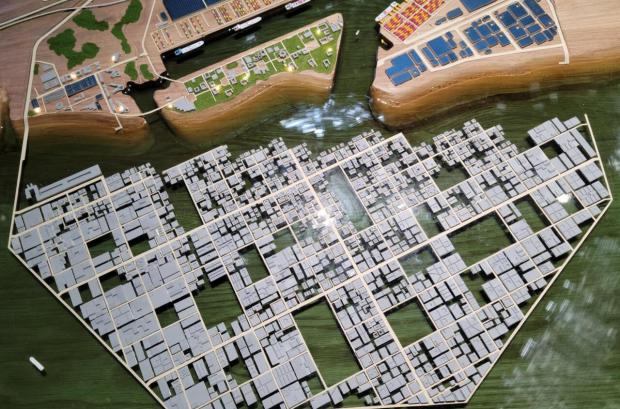
Three years later, the castle is already sinking.
When Crown Prince Mohammed bin Salman announced The Line on January 10, 2021, he promised a radical reimagining of urban life. "We need to transform the concept of a conventional city into that of a futuristic one."
Tucked into the upper corner of the kingdom's Tabuk province, the city would run like a ruler through the Neom region, housing nine million people, the population of Austria, within just 34 square kilometers, all powered by renewable energy. It imagines a world where every need sits within a five-minute walk, yet one can cross the entire city in twenty minutes. But even in a country wealthy enough to seed rain clouds and bankroll vast infrastructure, reality is colliding with ambition. The city that promised to "deliver new wonders for the world" is struggling to deliver its own foundation.
By 2030, only 2.4 kilometers of the 170-kilometer project will be completed, with the rest delayed as the government prioritizes energy infrastructure and scrambles for funding. The project's leadership has been reshuffled, with the head of the sovereign wealth fund, The Public Investment Fund, now steering the effort amid deepening financial uncertainty. This is unsurprising. The Line was imagined as an engineering object, an architectural marvel, rather than a city that must grow from real human demand. The economic foundation beneath that vision is equally unstable. Saudi Arabia's fiscal fortunes depend on oil, a commodity that swung from over $110 a barrel in 2012 to $42 in 2020 and now hovers near $70. The financial bedrock for this trillion-dollar city is, like the desert beneath it, shifting.
As urban planner and George Mason scholar Alain Bertaud reminds us, cities are foremost labor markets, not works of art. "Planning," he argues, "is based on the illusion that a city is a complex building that needs to be designed in advance by competent professionals."
While the glossy Neom videos present a pristine, drone-filled future, they do so without answering the most basic question: who will live here? There is no target population beyond the slogan of "nine million," no industries identified, no international firms committed to office space. The Line sells a vision of technological abundance while omitting the people needed to make a city function. Additionally, the BBC reports that construction has already displaced local communities, some labeled as rebels, and that Saudi authorities justified lethal force against those resisting eviction. The Line lacks the basics, let alone the advanced futurism it advertises: no jobs lined up, no residents committed, and human rights violations overshadowing its image.
For years, Saudi Arabia has attracted foreign workers with the promise of zero income tax and a reputation for safety. But these incentives, however appealing, are not in and of themselves a foundation for long-term economic growth. As Nobel laureate Daron Acemoglu argues, it is institutions, not tax perks or security guarantees, that sustain prosperity. On this front, Saudi Arabia functions less like an open society and more like a modern caste system, granting its citizens far broader rights and protections than the millions of residents, roughly 40 percent of the population, who live and work there. Citizens benefit from public goods such as public schools, where non-Saudis are capped at just 15 percent of enrollment, as well as welfare programs universally free for nationals. Foreigners, by contrast, are routed into private institutions and face sharply limited paths to citizenship waiting 10 years to apply, and even then nothing is guaranteed. This is a separation not only of services, but of ideas and talents. Even the labor market reflects this hierarchy.