










Breaking News
 Still Discriminating
 Nike CEO may have just admitted the company went too woke as stock hits 12-year low
 Will Europe Be Annihilated Over Kaliningrad?
 The Last Asset--You Will Own Nothing
Top Tech News
 Most artificial limbs rely on silicone or plastic to mimic human hands.
 Flying cell tower beams phone signal to Japan from 10 miles up
 Chinese Commercial Reactor Achieves Nuclear Fusion with Clean Hydrogen-Boron Fuel
 Med Beds Just Took a MASSIVE Step Forward, Healing People in Days!
 Palmer Luckey: Autonomous Weapons Are Ancient and Why Anduril Won't Build Humanoids | EP #295
 A laser just photographed objects through six feet of concrete
 Elon Musk's Next-Gen Motor Destroy Entire EV Industry
 China's disputed satellite refueling heralds new space war era
 BYD Will Put Solid-State Batteries In An EV Next Year: Executive
 FDA-cleared exoskeleton puts spinal-cord patients back on their feet



Magnetic and modular LEDs can cover a wall in light
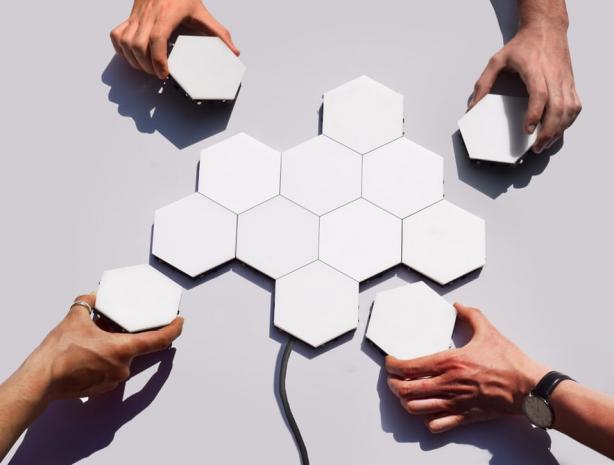
That is the principle behind the Helios modular LED lighting system, where hThe Helios system is similar to the Nanoleaf Aurora Smarter Kit, which uses 8.25 x 9.4 in (21 x 24 cm) triangular panels in a similar way. The hexagonal Helios modules are smaller, though, at 4.3 in (11 cm) across their longest span and 0.4-in (1-cm) thick, and do not feature the smart and color changing properties of the Nanoleaf system. They are designed less for eye-catching aesthetics and more as a functional and elegant means of lighting a room.
Dyena, the firm behind the Helios system, explains that the aim is for users to be able to turn the interior architecture of a space into a light source. A few of the modules could be use together at a desk to provide light when working or a whole wall could be covered in them.