










Breaking News
 Amazon Boeing Plane Bursts Into Flames After it Overshoots Runway at Miami International Airpot
 Trump grants clemency to 30 people, White House pardon czar says
 Bessent: "CUT THE SNAKE'S HEAD OFF"--But Who is the Real Target?
 Special LIVE Saturday Show: Could The Gov Seize XRP After Chilling FDIC Admission? Gas Prices...
Top Tech News
 Floating data center would provide water and electricity to 32,000 homes
 OpenAI Cuts Off Elon's Cursor, Humanity's First Star Probe, and Trump's Nuclear Mars Shi
 Eating pollution? Plastic-to-cookie technology raises safety, environmental concerns
 Ford's $30,000 Fathom EV Truck Appears More Conventional Than Expected
 Berlin-based artist Simon Weckert explored that idea with Digital Camouflage...
 Tether expands tokenization business into Saudi Arabia, starting with real estate
 Ukraine is facing a new problem in its war with Russia:
 It charges more than it discharges while driving
 Dataminr AI tech to go live on NATO Maven system: CEO
  The Most Dangerous Interview Ever Recorded? PART 2


Breakthrough Propulsion Architecture gets Phase 2 NIAC funding
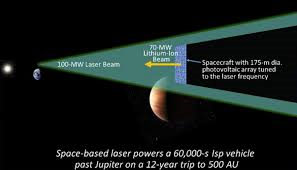
S
uch a system would enable missions with characteristic velocities of 100 to 200 km/s, and would enable a mission to the solar gravity lens location of 550 AU in less than 15 years.
The Phase I study investigated all of the key assumption made in the original proposal including:
* the feasibility of developing photovoltaic arrays with an areal density of 200 g/m^2;
* the feasibility of developing a high power electric propulsion system with a specific power of less than 0.3 kg/kW;
* the feasibility of developing photovoltaic cells tuned to the frequency of the laser with efficiencies of greater than 50%;
* and the feasibility of being able to point the laser array with the required accuracy and stability necessary to perform the reference mission to the solar gravity lens location.
The Phase I work identified plausible approaches for achieving each of these technology goals. In addition, the Phase I work looked at the system engineering of the entire propulsion system architecture with the objective of minimizing the laser aperture size.