










Breaking News
 Amazon Boeing Plane Bursts Into Flames After it Overshoots Runway at Miami International Airpot
 Trump grants clemency to 30 people, White House pardon czar says
 Bessent: "CUT THE SNAKE'S HEAD OFF"--But Who is the Real Target?
 Special LIVE Saturday Show: Could The Gov Seize XRP After Chilling FDIC Admission? Gas Prices...
Top Tech News
 Floating data center would provide water and electricity to 32,000 homes
 OpenAI Cuts Off Elon's Cursor, Humanity's First Star Probe, and Trump's Nuclear Mars Shi
 Eating pollution? Plastic-to-cookie technology raises safety, environmental concerns
 Ford's $30,000 Fathom EV Truck Appears More Conventional Than Expected
 Berlin-based artist Simon Weckert explored that idea with Digital Camouflage...
 Tether expands tokenization business into Saudi Arabia, starting with real estate
 Ukraine is facing a new problem in its war with Russia:
 It charges more than it discharges while driving
 Dataminr AI tech to go live on NATO Maven system: CEO
  The Most Dangerous Interview Ever Recorded? PART 2


Orbits and lighting levels for artificial moon satellite over China
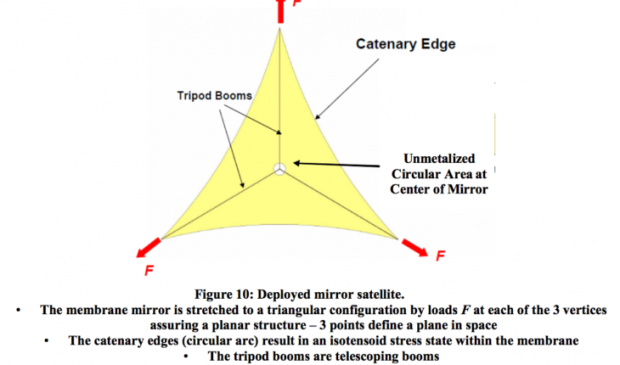
This article is referring to Chinese statements about their mirror moonlight system and referencing a presentation "Mirrors in Dawn Dusk Orbit for Low-Cost Terrestrial Solar Electric Power in the Evening" at the AIAA tech conference on 2013. The work in China has to obey the physics and orbital mechanics of such light reflecting systems. Lewis M. Fraas JX Crystals and
Billy Derbes and Arthur Palisoc of L'Garde Tustin, CA wrote the AIAA paper.
China plans to put an artificial moon in orbit above Chengdu, capital of Sichuan province, from the Xichang Satellite Launch Center in Sichuan by 2020. If the launch proves successful, three more such objects will be launched in 2022, Wu Chunfeng, head of Tian Fu New Area Science Society in Chengdu.
Astronomers complain that the artificial moon mirrors would make light pollution 50 times worse.