










Breaking News
 Amazon Boeing Plane Bursts Into Flames After it Overshoots Runway at Miami International Airpot
 Trump grants clemency to 30 people, White House pardon czar says
 Bessent: "CUT THE SNAKE'S HEAD OFF"--But Who is the Real Target?
 Special LIVE Saturday Show: Could The Gov Seize XRP After Chilling FDIC Admission? Gas Prices...
Top Tech News
 Floating data center would provide water and electricity to 32,000 homes
 OpenAI Cuts Off Elon's Cursor, Humanity's First Star Probe, and Trump's Nuclear Mars Shi
 Eating pollution? Plastic-to-cookie technology raises safety, environmental concerns
 Ford's $30,000 Fathom EV Truck Appears More Conventional Than Expected
 Berlin-based artist Simon Weckert explored that idea with Digital Camouflage...
 Tether expands tokenization business into Saudi Arabia, starting with real estate
 Ukraine is facing a new problem in its war with Russia:
 It charges more than it discharges while driving
 Dataminr AI tech to go live on NATO Maven system: CEO
  The Most Dangerous Interview Ever Recorded? PART 2


JAXA and Toyota team up on manned Moon rover concept with 10,000-km range
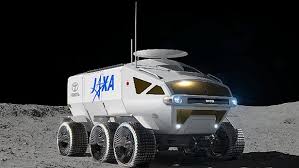
With a range of 10,000 km (6,200 mi), the rover would be about the size of two minibuses and could carry two passengers, or up to four in an emergency.
If the next generation of astronauts to reach the Moon expect to be more than tourists, they are going to need some serious transportation. Though Earth's nearest neighbor may look small as it hangs up in the sky, it's much larger than many people think, with a surface area equivalent to that of Africa. It also has some very rough, mountainous terrain and an environment that is the very definition of hostile.
All of this would be bad enough on Earth, but on the Moon any visitor has to move about in a pressure suit that makes even the simplest of tasks as difficult as deep sea diving in mixed-gas gear, and in which only the shortest of hikes is practical.
It's for this reason that the later Apollo missions included a two-man electric go-kart to carry the astronauts and their gear. It's also the reason why JAXA and Toyota are keen on the idea of a pressurized rover where explorers can work in a shirt sleeve environment and travel for thousands of miles at a go.