










Breaking News
 The Deep State's Get-Out-Of-Jail-Free Card
Why Not Stop Mass Immigration into the United States?
 French President Macron's Popularity Falls to Record Low of 16 Per Cent
 Top Signs You're Heading for a Quagmire
Top Tech News
 NASA Super Light Solar Sail Project Will Be 12-40 Times Lighter and Faster
 Space Telescope Interferometer to Image Exoplanet Continents
 Twenty-five years of "temporary": how 9/11 built a surveillance state Americans never vote
 I'll Never Buy Another WALMART Battery!
 Shoei GT-Air 3 Smart helmet drops with built-in AR for $1,500
 Freezable titanium plate keeps your cooler chilled way longer than ice packs
 Review: Affordable thermal device is made for discovering life outdoors
 AI Whistleblower Tells Tucker How AI Could Kill All Humans by 2040
 You Hate Flock? Well There's More...
 Will Spiking Diesel Prices Drive Autonomous Trucking?



IBM 53 Qubit Cloud Accessible Quantum Computer and Nextbigfuture Interviews Bob Sutor...
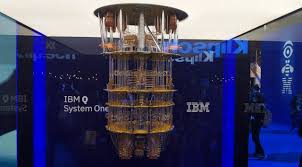
Today, IBM (NYSE: IBM) announced the opening of the IBM Quantum Computation Center in New York State. The new center expands the world's largest fleet of commercial quantum systems existing beyond the confines of experimental lab environments. This includes five 20-qubit systems with a Quantum Volume of 16 – a measure of the power of a quantum computer – demonstrating a new milestone in quality and reproducibility. Within one month, IBM's commercially available quantum fleet will grow to 14 systems, including a new 53-qubit quantum computer, the single largest universal quantum system made available for external access in the industry, to date.
IBM new quantum systems will start at the same Quantum Volume as its previous cloud quantum system. The new 53-qubit quantum computer will have its Quantum Volume increased as more refinements and testing is made over the next few months.
IBM is making various software available at Qiskit.
Question – What is the future vision of Quantum solutions?
The quantum software and hybrid solutions that IBM is creating will become a development and solution stack. They already offer libraries of quantum algorithms and application-specific code.