










Breaking News
 At least 10 prominent athletes DIED UNEXPECTEDLY or were struck by anomalous medical...
 How "Argentina's Elon Musk" Is Bringing Technocracy To Patagonia
 Megyn Kelly on the Serious Challenges Russell Brand Faces with Allegations from over 20 Years Ago
 YOUR APPLIANCES ARE COLLECTING DATA, AND WHAT THIS COFFEE MAKER WAS CAUGHT...
Top Tech News
 Genetically Engineered War Dogs for 134 Pound Cyborg Dire Wolves Now – Later 600 Pound Wolves
 They're Quietly REPLACING Our Food With THIS… And Nobody Is Talking About It!
 Chicago Opens First "Teacher-Free" AI School as Global Push Accelerates
 Solar Panels Are Doing Something Nobody Expected
 DeLorean climbs skyward to race electric flying cars
 Atari's 800XL returns with a keyboard, cartridges and BASIC
 Bioinspired robot airdrops into remote waters via morphing wing-sail
 Anduril interceptor adapts to emerging threats via swappable stages
 I Built a Website to Expose Solar and Battery Scams
 Whistleblower Issues Dire Warning: Rogue AI, Hacking Nuclear Programs...



Hyperadobe Step-by-Step
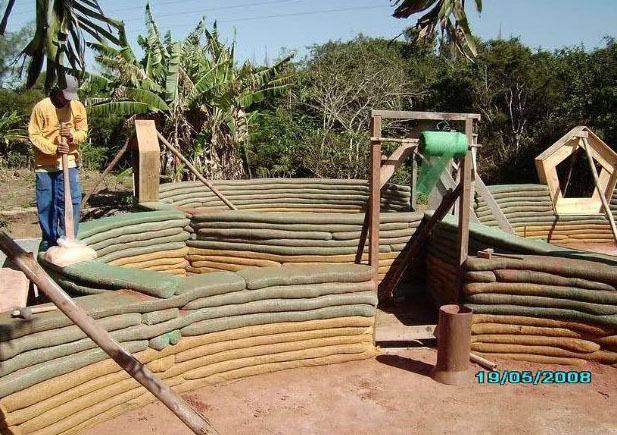
The big difference between the two is that Superadobe uses woven polypropylene bags with barbed wire between the layers, whereas Hyperadobe uses a knit raschel, the same material used in packaging fruit. This leads to less cost compared to the poly bags.
Raschel is a knitted fabric which resembles hand crocheted fabrics, lace fabrics, and nettings. Raschel warp knits contain inlaid connecting yarns in addition to columns of knit stitches.
The raschel need not be burned to receive the plaster; Fernando works it as a "roughcast" to receive natural plaster. With vertical walls there is no need for barbed wire between the layers because with the open netting the soil of the bottom layer is merged with the new layer above.
The dream begins with site selection and marking the floor.
Foundation construction using forms that allow curves.
Here the foundation has been poured. The entrance frame was set into place before laying the Hyperadobe.
The layers of Hyperadobe begin with the soil chosen for the work, which is generally about 70% sand and 30% clay, but this can vary. It must have a good moisture content, neither too wet nor too dry, and this comes with practice.
To facilitate the placement of the netting, it is necessary to support a coil above the funnel. Four hands are best. The ideal is to have two funnels so that when you finish one the other is ready to go.
We developed a shoulder strap to make it easier to hold the funnel.
The funnel should be held with both hands at chest height. Roll out a little of the bag, fold the tip in your direction near where the layer will start. Step on the tip to dispense the soil at this point so you have full control of the material.