










Breaking News
 The Middle East Security Map Is CHANGING FAST! Saudi Arabia, Pakistan & Turkey Move Toward...
 Report: US Troops and Diplomats Evacuating Posts Across the Middle East
 The USDA's $8 Billion Farmer Bailout Is Communism Disguised as Relief
 Sell The Bailout: Skydance Tumbles As Musk's $1 Billion Check Reminds Everyone Paramount...
Top Tech News
 Chicago Opens First "Teacher-Free" AI School as Global Push Accelerates
 Solar Panels Are Doing Something Nobody Expected
 DeLorean climbs skyward to race electric flying cars
 Atari's 800XL returns with a keyboard, cartridges and BASIC
 Bioinspired robot airdrops into remote waters via morphing wing-sail
 Anduril interceptor adapts to emerging threats via swappable stages
 I Built a Website to Expose Solar and Battery Scams
 Whistleblower Issues Dire Warning: Rogue AI, Hacking Nuclear Programs...
 Multi-material insulation delivers up to 10,000 x the stiffness
 Anduril's plan to save US sub edge from China's undersea surge



The day of the tactical laser weapon arrives
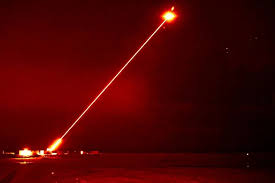
When the invention of the laser by Theodore Maiman at the Hughes Research Laboratories was made public on July 7, 1960, the press immediately saw the military possibilities, with the Los Angeles Herald proclaiming "LA Man Discovers Science-Fiction Death Ray."
In the months and years that followed, popular media would often talk about the destructive potential of lasers with the Associated Press publishing an article that proclaimed that a satellite armed with a laser could control the Earth. Concepts of laser weapons were common while thrillers like 1964's Goldfinger cemented the concept of the laser weapon in the public's mind.
However, reality was very, very far behind. For years the laser was infamous as the solution in search of a problem and although lasers could be spectacular, they were hardly weapons-grade in the 1960s. Just look at the fact that the power of the laser then was measured in Gillettes. That is, how many razor blades a laser beam could cut through at one time.
Even as the laser found applications in science and technology, giving rise to miracle surgery and revolutionary communications, lasers mainly found military applications as targeting systems and range finders. The only real laser weapon that saw service during the 20th century was a low-power laser used by the Royal Navy during the 1982 Falklands War to temporarily dazzle and distract enemy pilots.
Not that this was due to lack of trying. Both the US and the Soviet Union had ambitious programs to develop laser weapons. The Americans even modified a Boeing 747 to carry a huge experimental and alarmingly dangerous chemical laser designed to shoot down intercontinental ballistic missiles that was more of a menace to the crew than the missiles.
In the past two decades the development of a new generation of lasers began to change all this. The basic problem was three fold. First, figure out how to make a laser with enough power to be practical. Second, learn how to seek targets. Third, how to adjust the beam to compensate for atmospheric effects.
The breakthrough was the development of solid-state lasers that use bundles of glass fibers doped with exotic elements like ytterbium, erbium, and thulium along with aluminum, germanium, and phosphorus. These curled up bundles allowed for very long, efficient lasers to be stuffed into very small volumes and new technologies allowed multiple lasers to be combined into a single, far more powerful beam.
At the business end, new targeting systems were developed to identify and lock onto targets quickly. Along with this came systems that used things like reference lasers to analyze the air between the weapon and target so the deadly beam could be altered to compensate for any distortion.