










Breaking News
 Total PsAI-Op: How Altman, Amodei, And The 'EA' Cult Are Milking "Rogue AI" Breako
 The Arctic Front Of The "Cordon Sanitaire" Is The Most Threatening To Russia
 Big Oil Backs Mazama's $135 Million Bet On Superhot Geothermal
 Ukraine Pounds Major Moscow Refinery As Global Diesel Crisis Threatens Economic Shock
Top Tech News
 Terrifying AI Behavior Even Its Creators Couldn't Explain
 WW3 Near-Miss? AI Hallucinated Nuclear Weapons Components Aboard Chinese Vessel Bound For Iran
 Stripe Is Building the Toll Road for the Machine Economy
 Toyota Dakar hopeful swaps twin-turbo V6 for hydrogen fuel cells
 4-min turbo-inflatable cubic camp castle is now available in the USA
 Researchers Used Claude To Hack OpenAI Employee Accounts
 Chinese Scientists Develop New Oil Refining Method That Cuts Energy Use by 90%
 World's smallest CT scanner fits in the palm of your hand
 The Tesla Roadster will blow people's minds
 Peter Thiel-Funded Company Anduril to Triple the Number of Autonomous Surveillance Towers...



Humanoid Robots Get "Brains" As Dual-Use Fears Mount
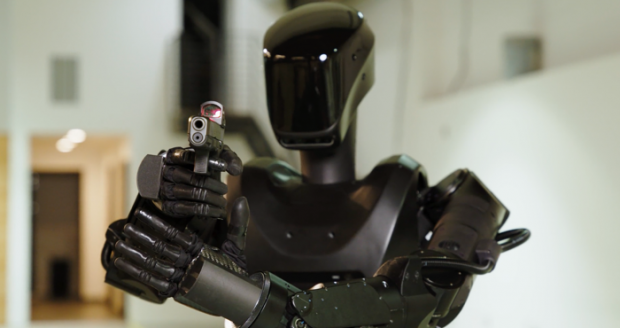
Once these intelligent models push beyond scripted video stunts - we've all seen in promotional videos - into real-world autonomy, the systems become battlefield-ready, dual-use robots.
The Shanghai Morning Post reports that China-based robotics firm Dobot has developed Dobot-VLA, a vision-language-action model that allows its full-size humanoid Atom robot to "see through" clusters of tasks, "understand" ambiguous instructions, and make autonomous decisions to "get the job done."
"[This] ability to adapt autonomously based on an understanding of the environment is the starting point for humanoid robots to create value in industrial applications," the company told SCMP.
Rival UBTech open-sourced its humanoid-focused multimodal model, "Thinker," on GitHub and Hugging Face, aiming to address common embodied-robot issues such as lag and spatial inaccuracies.
UBTech claims strong benchmark results against Nvidia and ByteDance models and reports near-perfect performance (99.9%) on certain factory-floor tasks, such as moving boxes and sorting parts, with its "Walker S2" humanoid robot.
SCMP pointed out, "China's robotics industry is accelerating a shift from physical stunts that rely on preprogrammed routines to sophisticated abilities that require learning and adapting in the real world, seen as essential for mass commercial adoption in manufacturing and other scenarios."
The broader theme is that humanoid robot brains are being developed at hyperspeed, suggesting these robots will be marching on factory floors in the very near term, not just in China but also across the Western world, starting later this year.
We've warned readers that "Humanoid Robots Begin March on Assembly Lines and Beyond," meaning some of these systems could be dual-use and could soon appear at polygon weapon-testing facilities in Ukraine, potentially headed for battlefield deployment later this year if there's no peace deal by spring. The same could be said of Russian forces, which may soon be experimenting with Chinese bots.
Skynet is already here.