










Breaking News
 Rising Prices and Falling Values--Inflation and Social Decay
 The non-Zionist Israeli Population Could Save the Day
 AfD Launches 'Knife App' As Berlin Violence Surges
 Oil Prices EXPLODE After Trump Signals That US Is Moving To Wartime Economy
Top Tech News
 DARPA O-Circuit program wants drones that can smell danger...
 Practical Smell-O-Vision could soon be coming to a VR headset near you
 ICYMI - RAI introduces its new prototype "Roadrunner," a 33 lb bipedal wheeled robot.
 Pulsar Fusion Ignites Plasma in Nuclear Rocket Test
 Details of the NASA Moonbase Plans Include a Fifteen Ton Lunar Rover
 THIS is the Biggest Thing Since CGI
 BACK TO THE MOON: Crewed Lunar Mission Artemis II Confirmed for Wednesday...
 The Secret Spy Tech Inside Every Credit Card
 Red light therapy boosts retinal health in early macular degeneration
 Hydrogen-powered business jet edges closer to certification


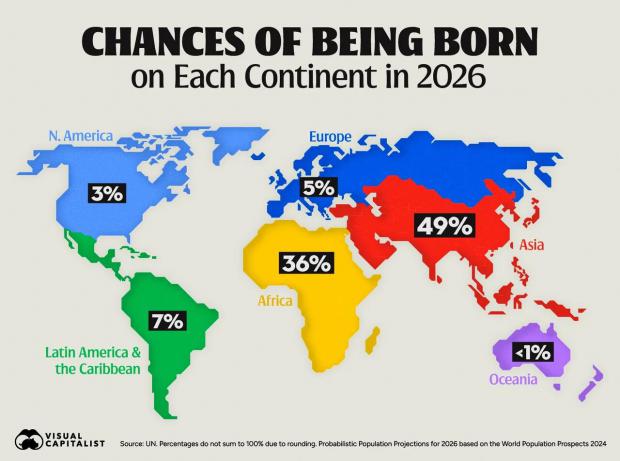
85% Of Babies In 2026 Will Be Born In Asia And Africa
Where someone is born can shape everything from access to education and healthcare to long-term economic opportunity.
This map, via Visual Capitalist's Bruno Venditti, shows how global births are distributed across continents, based on population projections from the United Nations.
Asia Accounts for Nearly Half of Global Births
Asia is expected to see about 64.9 million births in 2026, accounting for roughly 49% of all births worldwide. Despite declining fertility rates in countries like China, Japan, and South Korea, Asia's sheer population size keeps it at the center of global demographics.

South and Southeast Asia, in particular, continue to contribute large numbers of births each year. As a result, nearly one in every two people born in 2026 will be born somewhere in Asia.
Africa Makes Up More Than One-Third of Global Births
Africa is projected to record 47.6 million births in 2026, representing 35.9% of the global total. This reflects the continent's high fertility rates and young population structure.
Many African countries are still early in their demographic transitions, with limited declines in birth rates so far. As population growth accelerates, Africa's share of global births has been rising steadily and is projected to increase further later this century.
Smaller Shares in the Rest of the World
All other continents account for a relatively small share of global births.
Latin America and the Caribbean are expected to see 9.3 million births, or 7% of the total, while Europe accounts for just 4.6%. North America's share stands at 3%, reflecting lower fertility rates despite population growth driven by migration. Oceania contributes 0.5% of births, and Antarctica, with no permanent population, records no births at all.