










Breaking News
 Engineered Energy & Food Crisis? Christian Westbrook on RCR Media with Paul Brennan
SEMI-NEWS/SEMI-SATIRE: April 5, 2026 Edition
 Rising Prices and Falling Values--Inflation and Social Decay
 The non-Zionist Israeli Population Could Save the Day
Top Tech News
 DARPA O-Circuit program wants drones that can smell danger...
 Practical Smell-O-Vision could soon be coming to a VR headset near you
 ICYMI - RAI introduces its new prototype "Roadrunner," a 33 lb bipedal wheeled robot.
 Pulsar Fusion Ignites Plasma in Nuclear Rocket Test
 Details of the NASA Moonbase Plans Include a Fifteen Ton Lunar Rover
 THIS is the Biggest Thing Since CGI
 BACK TO THE MOON: Crewed Lunar Mission Artemis II Confirmed for Wednesday...
 The Secret Spy Tech Inside Every Credit Card
 Red light therapy boosts retinal health in early macular degeneration
 Hydrogen-powered business jet edges closer to certification


Human Brain Cells Merge With Silica To Play DOOM
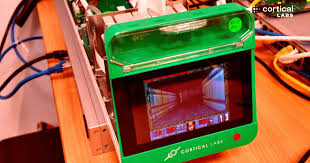
In a development that sounds like a Black Mirror script, Australian biotech firm Cortical Labs has taught clusters of human brain cells – grown in a lab – to interact with the iconic video game Doom.
With roots in earlier work that had these "mini-brains" mastering Pong, the leap to Doom signals rapid progress in biological computing. Critics worry this tech, backed by agendas that prioritize efficiency over ethics, might pave the way for dytopian nightmare scenarios where values of self-reliance and human dignity fall by the wayside.
The breakthrough involves roughly 800,000 to one million living human neurons clustered in a petri dish, forming what the company calls "mini-brains." These cells, stimulated by electrical signals from a computer, learn to respond in ways that control actions in the game.
Engineers at Cortical Labs translated Doom's digital environment into patterns the neurons could process. The cells' firing patterns then dictate moves like shooting or navigating.
"So we showed that biological neurons could play the game Pong," Cortical Labs chief scientific officer Brett Kagan explained in a video announcement. "This was a massive milestone because it demonstrated adaptive, real-time, goal-directed learning."
Building on that 2022 achievement, the team tackled a tougher challenge. "Doom was much more complex," Kagan added. "It's 3D. It has enemies. It needs to explore, its an environment, and it's hard."
The system, dubbed the CL1 biological computer, allows remote interaction with these living neurons via an online platform. For now, the cells perform like novices, but the learning curve is evident.
"If the neurons fire in a specific pattern, the Doom guy shoots," said Cortical Labs chief technology officer David Hogan. "If they fire in another pattern, he moves right."
Back in 2022, Cortical Labs grabbed headlines with their Pong-playing neurons, proving biological systems could adapt in real time. Now four years later, the same tech has evolved to handle Doom's demands, with reports confirming around 200,000 neurons fused with silicon chips enabling gameplay.
Other sources highlight the CL1 as a "code deployable biological computer," shipped since last year, blending human cells with traditional computing. Developers access it remotely, hinting at scalable applications.
Yet, as this tech matures, questions arise. Proponents tout potential for AI or robotics, but skeptics see echoes of transhumanist fantasies peddled by global elites at forums like Davos.
Imagine neural networks powering drones or surveillance tools – a dream for deep state operatives, a nightmare for privacy advocates.