










Breaking News
 Has A Global Catastrophe Been Averted, Or Is This Just A Very Temporary Reprieve?
 Blocking The Internet Archive Won't Stop AI, But It Will Erase The Web's Historical Record
 Here is why Nasdaq and owner of NYSE are putting the $126 trillion equity market on blockchain
 JFK: The Memo That Might Have Stopped Israel's War on Iran
Top Tech News
 We Build and Test Microwave Blocking Panels - Invisible to Radar
 Man Successfully Designs mRNA Vaccine To Treat His Dog's Cancer
 Watch: Humanoid robot gets surprisingly good at tennis
 Low-cost hypersonic rocket engine takes flight for US Air Force
 Your WiFi Can See You. Here's How.
 Decentralizing Defense: A $96 Guided Rocket Just Put Precision Warfare into the Hands of the People
 Israel's Iron Beam and the laser future of missile defense
 Scientists at the Harbin University of Science and Technology have pioneered a sophisticated...
 Researchers have developed a breakthrough "molecular jackhammer" technique...
 Human trials are underway for a drug that regrows human teeth in just 4 days.



I Traveled Through TSA Democrat Shutdown Chaos So You Don't Have To
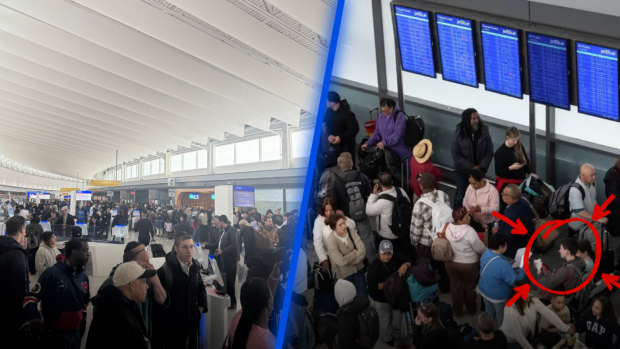
The experience was not defined by inconvenience alone; it exposed a systemic breakdown that affected thousands of travelers in real time.
The TSA checkpoint line stretched for hours, baggage drop lines extended deep into the terminal, and even locating the start of security became its own prolonged ordeal.
What should have been a routine travel day turned into a case study in how quickly infrastructure fails when government coordination collapses.
The TSA line itself took approximately four hours for most travelers around me. That figure, while striking on its own, does not fully capture the broader dysfunction. Checking a bag required more than an hour of waiting, often in lines that lacked clear direction or staffing.
Passengers moved slowly through overcrowded terminal spaces, with little guidance on what to do.
For travelers with disabilities, including those requiring wheelchairs, the situation was no better. Accessibility lines mirrored the same delays, reinforcing that this was not an isolated inefficiency but a complete operational failure.
The conditions inside the terminal created an environment that felt increasingly unsafe. Pre-security areas were packed beyond capacity, limiting movement and creating bottlenecks at nearly every point of entry.
With only a handful of TSA agents actively processing passengers, the ratio of staff to travelers appeared severely imbalanced.
That imbalance produced visible consequences. Travelers showed signs of physical distress after standing for extended periods in dense crowds, and multiple incidents appeared to require medical attention. These were immediate, human consequences of a partial government shutdown unfolding in front of thousands of people.
Air travel itself began to break down as a result. Flights were delayed not because of weather or mechanical issues, but because passengers could not physically reach their gates in time.
In several cases (including mine), planes waited for travelers who remained stuck in security lines due to the small number of passengers who actually made it to the flight.
The system had effectively stalled, unable to perform even its most basic function: moving passengers from check-in to departure in a predictable and orderly manner.