










Breaking News
BREAKING: United Nations COLLAPSE LOOMS! "RUNNING OUT OF MONEY"...
 Russian government judo-chops internet & cows
 Everything Congress Does is to Enrich Themselves, Impoverish Us, Kill our Children...
 Worse Than John McCain?
Top Tech News
 DARPA O-Circuit program wants drones that can smell danger...
 Practical Smell-O-Vision could soon be coming to a VR headset near you
 ICYMI - RAI introduces its new prototype "Roadrunner," a 33 lb bipedal wheeled robot.
 Pulsar Fusion Ignites Plasma in Nuclear Rocket Test
 Details of the NASA Moonbase Plans Include a Fifteen Ton Lunar Rover
 THIS is the Biggest Thing Since CGI
 BACK TO THE MOON: Crewed Lunar Mission Artemis II Confirmed for Wednesday...
 The Secret Spy Tech Inside Every Credit Card
 Red light therapy boosts retinal health in early macular degeneration
 Hydrogen-powered business jet edges closer to certification


U.S. Debt Just Crossed $39 Trillion

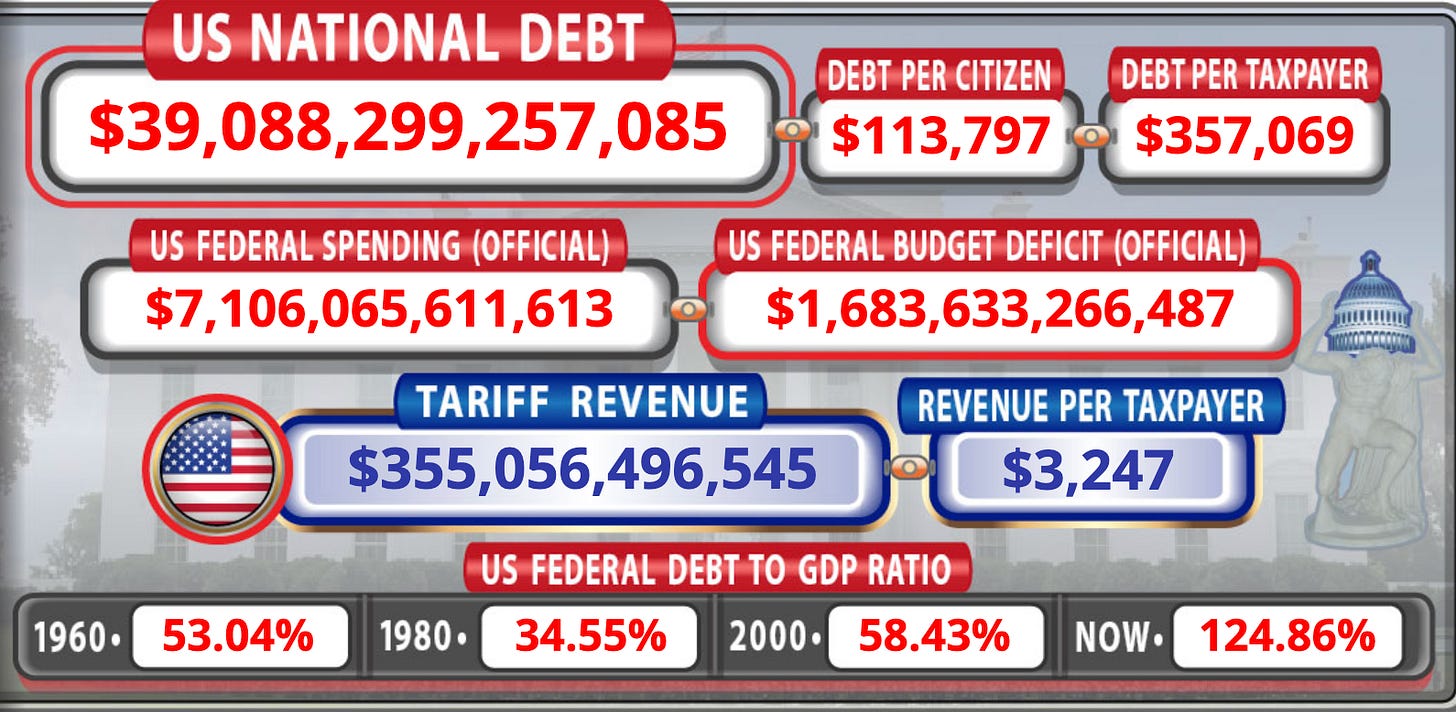
The U.S. has just smashed through another historic fiscal milestone — $39 trillion in national debt. That's roughly $357,000 for every U.S. taxpayer and nearly $114,000 for every American citizen.
But the headline number isn't what should worry you. It's the pace.
In January 2024, the national debt stood at $34 trillion. By August 2025, it crossed $37 trillion. By late October, $38 trillion. And now, $39 trillion. That's another $1 trillion piled on in roughly five months.
Back in September, I wrote that on the then-current trajectory, $40 trillion would arrive by late 2026. Turns out I was being conservative. At the current run rate, $40 trillion will be here before the end of fiscal year 2026 — September 30. Maybe sooner.
That's because Washington is now adding debt at a rate of about $8 billion every single day. Roughly $340 million every hour. Nearly $5.7 million every minute. You can step into the bathroom, and by the time you walk out, the U.S. will be another $25 million deeper in the hole.
And remember — this is all happening at a moment when there's no pandemic, no financial crisis, nothing on the scale of anything in the postwar record to "explain" it. In fact, the recent explosion in U.S. debt is unlike anything we've seen in the historical spikes during major wars and financial crises like the Civil War or World War II. There's no single exceptional event driving it. This time, the crisis isn't a moment — it's the system itself.
The Broken Promise
There's an irony here that's worth naming.
Before returning to the White House, Trump promised to pay off the national debt. Not reduce. Not stabilize. Pay it off. Instead, the debt has climbed by trillions — and has now nearly doubled from where it stood when he first took office in 2017. The DOGE effort that was supposed to take a chainsaw to spending got rounded down to a rounding error. The "Big, Beautiful Bill" added trillions in projected new deficits over the next decade. And now an Iran war that nobody budgeted for is layering its own bill on top of all of it — with the Pentagon already hitting up Congress for another $200 billion in supplemental war funding.