










Breaking News
 Alex Jones Live: As California Burns, Newsom Stands Down Again!
 Susie Wiles Reportedly Orchestrated Zacharia's Firing With Hannity Hit
 The Biggest Winners And Losers From The Petrodollar's Decline
 US Quietly Shifts MQ-9 Reapers Into South America
Top Tech News
 I Built a Website to Expose Solar and Battery Scams
 Whistleblower Issues Dire Warning: Rogue AI, Hacking Nuclear Programs...
 Multi-material insulation delivers up to 10,000 x the stiffness
 Anduril's plan to save US sub edge from China's undersea surge
 Researchers Develop AI 'Mind-Reading' Tool That Reconstructs What Your Eyes See
 Video: Dexterous robot hand learns the delicate art of silk embroidery
 The computer that can read your mind:
 Seven apps. One craft
 SHOCK CASE REPORT: Advanced Alzheimer's Patient Regains Speech, Memory, Mobility...
 Most artificial limbs rely on silicone or plastic to mimic human hands.



Toyota Dakar hopeful swaps twin-turbo V6 for hydrogen fuel cells
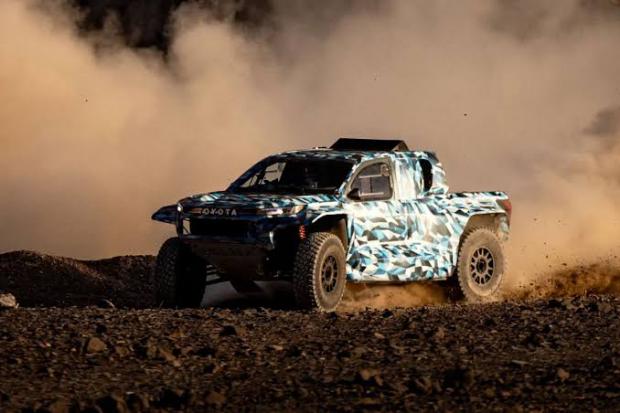
But next year Toyota's Gazoo Racing team is out to show that perhaps the future of extreme off-roading belongs not to roaring V6s – but to hydrogen. The company has just pulled the wraps off the Toyota DKR GR FC Hilux, a cutting-edge fuel-cell electric vehicle (FCEV) engineered to tackle the 2027 Dakar Rally in Saudi Arabia.
The pick-up truck replaces the twin-turbo petrol V6 found in the standard DKR GR Hilux with a zero-emission hydrogen powertrain.
Toyota chose a strategic, industry-focused reveal rather than the usual auto show glitzy unveiling. The hydrogen truck almost took second place to announcements about the technical alliances that are making the project possible. The international collaboration is spearheaded by Toyota Gazoo Racing but is working side-by-side with Jameel Motorsport – which conveniently has deep roots in Saudi Arabian motorsport.
To transform a standard Hilux into a hydrogen desert racer, Toyota also worked with Japanese automotive component giant DENSO, Toyo Tires and German engineering specialist IAV. The one-off truck is currently undergoing development, assembly and testing at Toyota's European Research and Development facility in Zaventem, Belgium. The engineers are evidently fine-tuning the complex thermal management systems required for desert survival with a hydrogen fuel cell.