










Breaking News
 New Study Says Grain Beats Grass: Joel Salatin Responds
 Stop Paying for Concrete - This Japanese Method Turns Plain Sand Into Solid Stone
 Solar Panels Plus Farming? Agrivoltaics Explained
 Cool knot techniques
Top Tech News
 I Built a Website to Expose Solar and Battery Scams
 Whistleblower Issues Dire Warning: Rogue AI, Hacking Nuclear Programs...
 Multi-material insulation delivers up to 10,000 x the stiffness
 Anduril's plan to save US sub edge from China's undersea surge
 Researchers Develop AI 'Mind-Reading' Tool That Reconstructs What Your Eyes See
 Video: Dexterous robot hand learns the delicate art of silk embroidery
 The computer that can read your mind:
 Seven apps. One craft
 SHOCK CASE REPORT: Advanced Alzheimer's Patient Regains Speech, Memory, Mobility...
 Most artificial limbs rely on silicone or plastic to mimic human hands.



3D-printed Martian mud homes look critical for life beyond Earth
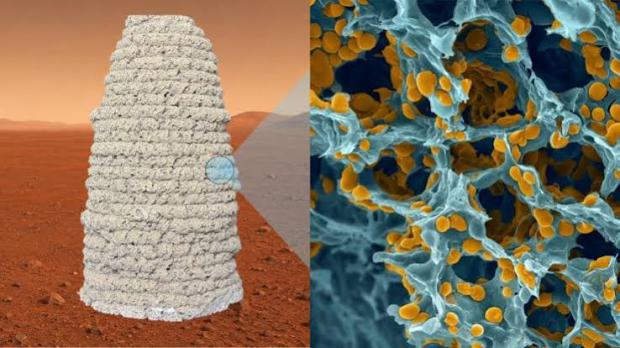
Scientists at the University of Hong Kong have developed a potential recipe for 3D-printing houses on Mars using ground-up Martian rock, gelatin, and yeast, with the latter two ingredients coming from Earth. The researchers say the mixture, once dried and hardened, is comparable in strength to low-grade concrete and could one day be used to build multi-story buildings on Mars. What's more, the material is alive, thanks to the yeast, allowing it to be recycled and regrown.
So, why are mud houses even in the conversation for a project as futuristic as a Martian colony? One reason is the red planet's environment. Mars is extremely cold, constantly blasted by radiation, and has an atmosphere that's 100 times less dense than Earth's; a few of the numerous peculiar conditions that can have disastrous effects on Earth-origin building materials and building processes.
For example, standard plastics, composites, sealants, and lubricants manufactured on Earth will release trapped gases and volatile compounds, and rapidly degrade in Mars' near-vacuum. Furthermore, intense solar ultraviolet (UV) radiation will break down the molecular bonds in organic polymers. Temperature swings and thermal stress will eventually crack structural steel and cause joints and seals to fail. Also, the water needed to make concrete will boil or freeze, and that's only if you can find the water.
Now, being the awesome species that we are, we've found ways to make earth-based materials work on Mars through extensive modification and protective shielding. The six rover vehicles we've sent over the last 29 years are proof. However, there's a planet-sized difference between sending a 1,025-kg (2,260-lb) craft, the heaviest of the rovers, and sending enough materials to erect a functional building. Which brings us to the second issue: sending building materials from Earth to space is prohibitively expensive and complex.
To circumvent these challenges, aerospace engineers and scientists plan to practice In-Situ Resource Utilization (ISRU), the use of materials already found on the planet. Scientists are already studying a number of approaches, including Martian concrete and 3D-printed regolith. However, some of these solutions require significant amounts of thermal energy. For example, sulfur concrete, made from abundant Martian sulfur and local dirt, is produced by heating the sulfur to its melting point of 115 °C to 120 °C (239 °F to 248 °F).
The Hong Kong researchers' proposed solution, detailed in the journal Chem Circularity, eliminates the need for any heating.
To make the material, they mixed specific proportions of sand from ground Martian rock and wet glue. The glue is made of gelatin and engineered yeast that is coated with highly adhesive proteins. The gelatin holds the ingredients together and provides a place for the yeast cells to grow, while the sand provides mass and structure. Once the mixture flows out of the nozzle, the Martian environment freeze-dries it. The water vapor evaporates, leaving microscopic pores behind. The resulting structure is light and porous, with good compressive strength.