










Breaking News
 A Dark Storm Is Gathering Over The Housing Market
 Listen: Final Song Recorded by Dolly Parton Released – 'It's Her Last Prayer… for America
 Brave Circle-K Worker Fired for Defending Himself, Co-Worker as Video Shows 4 Would-Be Robbers...
 Iran Downs US Aircraft As Israel Prepares 'Unprecedented Strikes' Amidst Election Turmoil
Top Tech News
 SpaceX Just Caught Starship on Its FIRST Attempt!
 Solid-State Cells Can Make The U.S. Competitive In Batteries Again: CEO
 Jetson ONE personal eVTOL pod is about to go full sky patrol
 America's INSANE BREAKTHROUGH Could Replace Septic Tanks Forever
 Amazing DIY Building Material for Home & Yard - Inexpensive and Easy!
 Researchers have discovered a massive deposit of hidden water...
 Amazon's Ring Unveils Flying Drone And Robot To Patrol Homes And Businesses
 Anthropic Strikes $3.4 Billion Off-Grid Power Agreement to Bypass U.S. Grids, Reports Say
 The X-ray room just shrank to the size of a laptop
 Gritt and MasTec partner to bring physical AI to solar construction sites



Advanced Small Modular Reactors (SMRs)
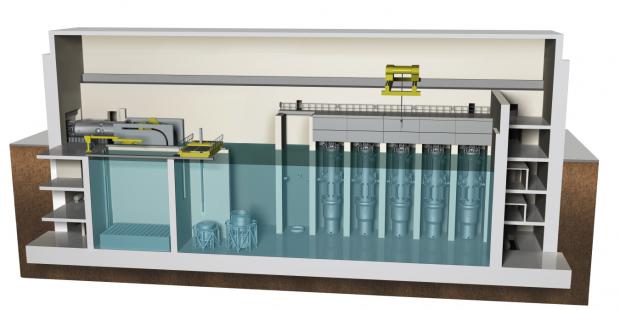
The advanced SMRs currently under development in the United States represent a variety of sizes, technology options, capabilities, and deployment scenarios. These advanced reactors, envisioned to vary in size from tens of megawatts up to hundreds of megawatts, can be used for power generation, process heat, desalination, or other industrial uses. SMR designs may employ light water as a coolant or other non-light water coolants such as a gas, liquid metal, or molten salt.
Advanced SMRs offer many advantages, such as relatively small physical footprints, reduced capital investment, ability to be sited in locations not possible for larger nuclear plants, and provisions for incremental power additions. SMRs also offer distinct safeguards, security and nonproliferation advantages.
The Department has long recognized the transformational value that advanced SMRs can provide to the nation's economic, energy security, and environmental outlook. Accordingly, the Department has provided substantial support to the development of light water-cooled SMRs, which are under licensing review by the Nuclear Regulatory Commission (NRC) and will likely be deployed in the late 2020s to early 2030s. The Department is also interested in the development of SMRs that use nontraditional coolants such as liquid metals, salts, and gases for the potential safety, operational, and economic benefits they offer.
Advanced SMR R&D Program
Building on the successes of the SMR Licensing Technical Support (LTS) program, the Advanced SMR R&D program was initiated in FY2019 and supports research, development, and deployment activities to accelerate the availability of U.S.-based SMR technologies into domestic and international markets. Significant technology development and licensing risks remain in bringing advanced SMR designs to market and government support is required to achieve domestic deployment of SMRs by the late 2020s or early 2030s. Through this program, the Department has partnered with NuScale Power and Utah Associated Municipal Power Systems (UAMPS) to demonstrate a first-of-a-kind reactor technology at the Idaho National Laboratory this decade. Through these efforts, the Department will provide broad benefits to other domestic reactor developers by resolving many technical and licensing issues that are generic to SMR technologies, while promoting U.S. energy independence, energy dominance, and electricity grid resilience, and assuring that there is a future supply of clean, reliable baseload power.
U.S. Industry Opportunities for Advanced Nuclear Technology Development
The Department issued a multi-year cost-shared funding opportunity (U.S. Industry Opportunities for Advanced Nuclear Technology Development, DE-FOA-0001817) in 2018 to support innovative, domestic nuclear industry-driven concepts that have high potential to improve the overall economic outlook for nuclear power in the United States. This funding opportunity will enable the development of existing, new, and next-generation reactor designs, including SMR technologies.