










Breaking News
 This is the future we shall bring into being
 Elon Musk's Vision For The Future Looks Like A Movie
 Phosphorus Munitions Fired by Israel Burn Groves, Orchards in Southern Lebanon
 Iran's IRGC Warns It Will Expand 'Geography of the War' If the US Attacks Again
Top Tech News
 BEYOND THE MOON: NASA plans a nuclear-powered fleet to push DEEPER into space
 Big Oil Backs Mazama's $135 Million Bet On Superhot Geothermal
 Quantum compass takes flight on Northrop's Lumberjack drone
 Terrifying AI Behavior Even Its Creators Couldn't Explain
 WW3 Near-Miss? AI Hallucinated Nuclear Weapons Components Aboard Chinese Vessel Bound For Iran
 Stripe Is Building the Toll Road for the Machine Economy
 Toyota Dakar hopeful swaps twin-turbo V6 for hydrogen fuel cells
 4-min turbo-inflatable cubic camp castle is now available in the USA
 Researchers Used Claude To Hack OpenAI Employee Accounts
 Chinese Scientists Develop New Oil Refining Method That Cuts Energy Use by 90%



Airbus Swears Its Pod/Car/Drone Is a Serious Idea Definitely
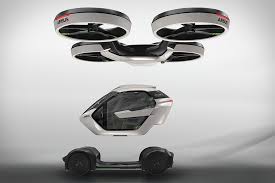
Air travel never involves air travel alone. City to city transport usually goes something like car or cab to train to shuttle to the terminal where you catch a plane, only to reverse the process at the other end, often with a little running somewhere along the line for good measure. Airbus came up with a crazy idea to change all of that with Pop.Up, a conceptual two-passenger pod that clips to a set of wheels, hangs under a quadcopter, links with others to create a train, and even zips through a hyperloop tube.
This crazy concept blurs the once-firm lines between planes, trains, and automobiles to let people take to the skies when traffic backs up. In other words, it's a flying car. A really cool flying car, cooked up with help from Italdesign and unveiled at the Geneva Motor Show, but still, a flying car. Farfetched, yes, but Airbus says it is taking the idea seriously. "Adding the third dimension to seamless multi-modal transportation networks will, without a doubt, improve the way we live, and how we get from A to B," said Mathias Thomsen, general manager for urban air mobility at Airbus.
Around town, the carbon fiber pod couples with an electric ground module and rolls along on a rather conventional four wheels. It's autonomous, of course, because everything is in the future. Don't want to creep along in gridlocked traffic? Simply summon an eight-rotor air module that resembles a supersized consumer drone. Clip in, take off, and enjoy a range that, should this technology ever actually work, will max out at about 60 miles. Whatever mode to choose, the Pop.Up parks itself at a recharging station upon arrival.
It all sounds crazy, but some big names see it happening. Dubai, the most superlative of emirates, plans to put people-carrying drones in service later this year. Last year, Uber said it could launch a flying car service within a decade. Such things will help wealthy (and brave) commuters skip over traffic, but don't solve the last mile problem unless your destination boasts a rooftop landing pad. That's where the Pop.Up idea enjoys an edge. It eliminates a key point of friction in multi-modal transportation: changing from one mode to the next. You just chill out in your pod.
Wanna hear the really crazy part? This scheme isn't as far-fetched as you might think.