










Breaking News
 If You Want to MAHA, Plant a Garden
 Iran's PressTV provides a different account of the War than Trump
 For peace with Iran to work a reckoning with Israel is in order
 SpaceX Revenue Will Be Close to Around $27-30 Billion in 2026
Top Tech News
 'World's First' Humanoid Robot For Real Household Chores Launched With 16-Hour Battery
 XAI Training 10 Trillion Parameter Model – Likely Out in Mid 2026
 The $7 Powder That Beats Your $5,000 AC Unit!
 Private credit is now a $3 trillion asset class and investors are receiving 45 cents on the dollar
 Converting Diesel Vehicles to Run on Waste Vegetable Oil, by Polar Bear
 Anthropic says its latest AI model is too powerful for public release and that it broke...
 The CIA used a futuristic new tool called "Ghost Murmur" to find and rescue...
 This Plant Replaces All Fertilizer FOREVER. Why Did the FDA Ban It?
 China Introduces Pistol-Like Coil-Gun Based On Electromagnetic-Launch Systems
 NEXT STOP: MARS IN JUST 30 DAYS?!


Video: Semicircular wings give Cyclone VTOL a different kind of lift
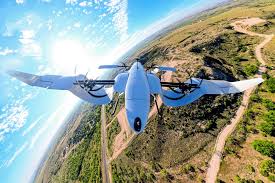
In 1925, a man named Willard Ray Custer had an interesting idea. Instead of getting an airplane to move at rapid speeds to create lift on its wings, why not move air over the wing using a propeller? So instead of pushing an entire plane through the air to get it skyward, you in effect, bring the air to the wings.
A few years later, Custer patented his design for a channel wing. This design, which features propellers set into a half-circle channel on each wing, provided planes shorter take-off distances thanks to lift at slower airspeeds. To demonstrate this, Custer had a man run alongside one of his channel wing planes until it lifted off the ground. In another test, Custer's team strapped the plane down, and turned on the propellers. The resultant lift the craft exhibited is probably the first instance of plane taking off vertically.
Unfortunately, Custer never found a way to make channel wings commercially viable. Planes back then were simply too heavy to make the system efficient.


