










Breaking News
 Amazon Boeing Plane Bursts Into Flames After it Overshoots Runway at Miami International Airpot
 Trump grants clemency to 30 people, White House pardon czar says
 Bessent: "CUT THE SNAKE'S HEAD OFF"--But Who is the Real Target?
 Special LIVE Saturday Show: Could The Gov Seize XRP After Chilling FDIC Admission? Gas Prices...
Top Tech News
 Floating data center would provide water and electricity to 32,000 homes
 OpenAI Cuts Off Elon's Cursor, Humanity's First Star Probe, and Trump's Nuclear Mars Shi
 Eating pollution? Plastic-to-cookie technology raises safety, environmental concerns
 Ford's $30,000 Fathom EV Truck Appears More Conventional Than Expected
 Berlin-based artist Simon Weckert explored that idea with Digital Camouflage...
 Tether expands tokenization business into Saudi Arabia, starting with real estate
 Ukraine is facing a new problem in its war with Russia:
 It charges more than it discharges while driving
 Dataminr AI tech to go live on NATO Maven system: CEO
  The Most Dangerous Interview Ever Recorded? PART 2


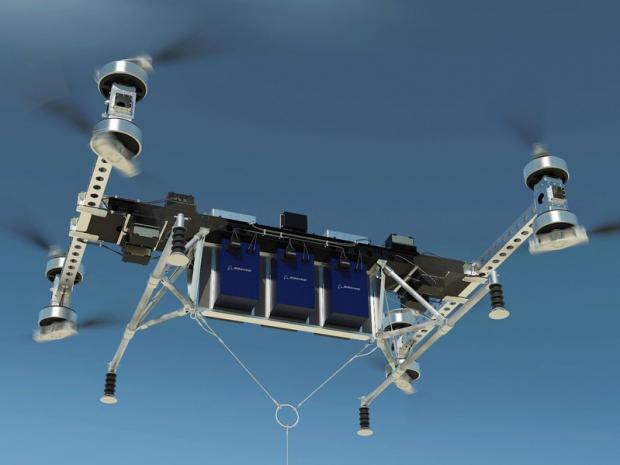
Boeing's Experimental Cargo Drone Is a Heavy Lifter
That's the vision pitched by the likes of Amazon, UPS, and DHL, and it's an appealing one.
Boeing has a different idea for delivery drones, one that's bigger by an order of magnitude. Last week, the aerospace giant revealed a prototype for an electric, unmanned cargo air vehicle that it says could haul as much as 500 pounds—that's 400 large Domino's pizzas or 11,291 newborn-sized diapers—as far as 20 miles. But this big buzzer isn't going to your house.
In fact, Boeing isn't quite sure where it's going. "It's a concurrent exploration of a nascent market and nascent technology," says Pete Kunz, the chief technologist for HorizonX, the Boeing skunk works-venture capital arm hybrid division that built this thing (the marketing team hasn't given it a catchy moniker yet).
A team of 50 engineers spent three months building what looks like a car-sized Erector Set, fitted with eight spinning blades (each six feet from tip to tip), and weighing in at an auspicious 747 pounds. It navigates and looks for obstacles using components and software provided by Near Earth Autonomy, a Pittsburgh-based company in which HorizonX invests.