










Breaking News
 Another Mass Shooter Stopped By Armed Citizen In Oregon
 Negative Political Ads: Voters Despise Them, But Campaigns Keep Using Them
 The Future Of American Drone Warfare
 The Precious Metals Crisis That Could Trigger A Global Financial Reckoning
Top Tech News
 I Built a Website to Expose Solar and Battery Scams
 Whistleblower Issues Dire Warning: Rogue AI, Hacking Nuclear Programs...
 Multi-material insulation delivers up to 10,000 x the stiffness
 Anduril's plan to save US sub edge from China's undersea surge
 Researchers Develop AI 'Mind-Reading' Tool That Reconstructs What Your Eyes See
 Video: Dexterous robot hand learns the delicate art of silk embroidery
 The computer that can read your mind:
 Seven apps. One craft
 SHOCK CASE REPORT: Advanced Alzheimer's Patient Regains Speech, Memory, Mobility...
 Most artificial limbs rely on silicone or plastic to mimic human hands.



Polydrop camping trailer optimized for EV towing and off-grid living
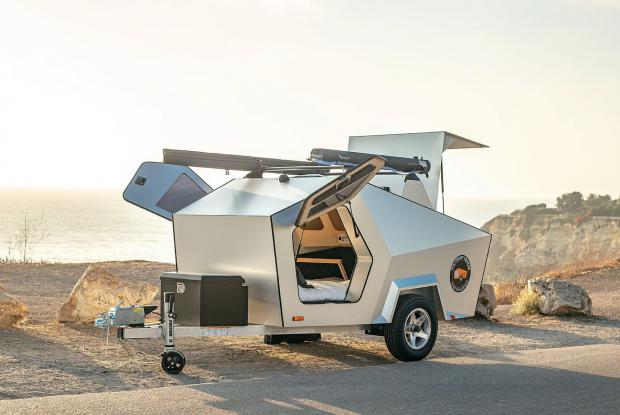
Now it's back with a more comfortable, fully equipped personal space specced to be something of a towable hotel room. The new P17A supports off-grid living with a powerful solar-charged lithium battery bank, all-weather battery-powered HVAC system and available kitchenette. It's a comfortable, climate-controlled tiny living space in which to disconnect for up to six days at a time.
The 13.6-foot (4.1-m) P17A trailer looks much the same as the slightly shorter original Polydrop when riding behind a tow vehicle. But Polydrops has done some considerable reshuffling behind the aluminum skin to optimize weight and layout around increased autonomy. The trailer's standard 2.4-kWh lithium-iron-phosphate battery gets integrated flatly into the heart of the aluminum frame, much like an EV skateboard chassis. This keeps weight as low and evenly distributed as possible.
Buyers looking for added battery power can double that pack to 4.8 kWh or jump up to the top-tier 12-kWh pack necessary to meet Polydrops' six-day off-grid estimate. Whatever option the buyer chooses, roof-mounted solar panels keep the battery charging at times it's not hooked up to external power. Polydrops equips the P17A with a standard 260-watt solar system, and buyers can double that setup for 520 watts. A pure sine wave inverter delivers power to the AC outlets and appliances.
The big layout difference between the P17A and previous Polydrops designs comes in the loss of the standard tailgate galley. The tailgate survives, but instead of opening up to a full-width kitchen, it opens directly to the main cabin and its full-size mattress. This saves weight on kitchen structural elements and appliances while giving the trailer a breezier, more scenic space in which to relax.