










Breaking News
 'PUTIN IS LAUGHING' Trump BETRAYED us, Zelensky slams… saying 'people will die' afte
 Topless pictures of Russell Brand taken by alleged rape victim at hotel shared in court
 Are the United States and Israel in Decline-and-Fall Mode?
 A Culture of Death
Top Tech News
 I Built a Website to Expose Solar and Battery Scams
 Whistleblower Issues Dire Warning: Rogue AI, Hacking Nuclear Programs...
 Multi-material insulation delivers up to 10,000 x the stiffness
 Anduril's plan to save US sub edge from China's undersea surge
 Researchers Develop AI 'Mind-Reading' Tool That Reconstructs What Your Eyes See
 Video: Dexterous robot hand learns the delicate art of silk embroidery
 The computer that can read your mind:
 Seven apps. One craft
 SHOCK CASE REPORT: Advanced Alzheimer's Patient Regains Speech, Memory, Mobility...
 Most artificial limbs rely on silicone or plastic to mimic human hands.



THAT'S NO MOON China announces plans for 1km-long orbiting spaceship...
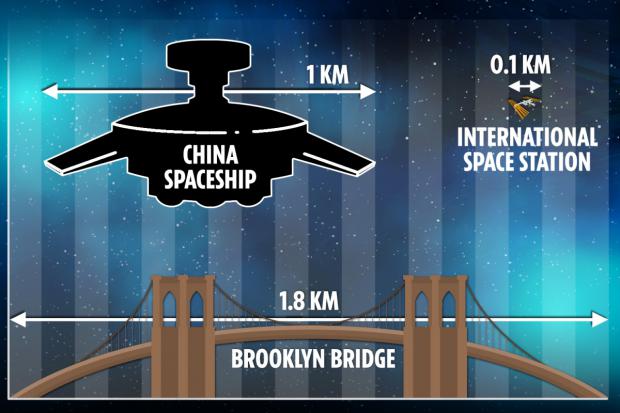
A HUGE spaceship up to 1km long could be built by China as the country's space agency is working on a plan for the build.
The National Natural Science Foundation revealed a four year programme is in place to try and work out if they could build such a large ship in orbit.
This would require sending components up to space on rockets and somehow assembling the spaceship in zero gravity conditions.
China's foundation said it was looking at "space equipment for future exploration".
It has the goal of having a "long-term stay" in orbit.
If the a 1km spaceship was built, that would make it 10 times bigger than the International Space Station.
China's state media has revealed that the plans are complicated.
Components of the craft would need to be as light as possible to make construction viable.
A large spaceship has never been built in orbit before.
China is currently assembling its own space station, just like the ISS, in orbit.
The main section of China's Tiangong space station was put in orbit back in April.
It's floating 236 miles above the Earth.
China has planned another 11 missions in the next year and a half to finish off building the space station.