










Breaking News
 Netanyahu Says Iran May Try To Disrupt Israeli Election With Attacks
 Trump Fires Another Salvo Into Israeli Politics As Netanyahu Neck-and-Neck With Gadi Eisenkot
 'Prison For Reich': Musk Slams Former Labor Secretary Over Commie Fever Dream To Nationalize
 Rubio Urges Cubans To Partner With CIA To Bring Change To Communist Country
Top Tech News
 Modular phone promises total privacy at the flick of a switch
 Genetically Engineered War Dogs for 134 Pound Cyborg Dire Wolves Now – Later 600 Pound Wolves
 They're Quietly REPLACING Our Food With THIS… And Nobody Is Talking About It!
 Chicago Opens First "Teacher-Free" AI School as Global Push Accelerates
 Solar Panels Are Doing Something Nobody Expected
 DeLorean climbs skyward to race electric flying cars
 Atari's 800XL returns with a keyboard, cartridges and BASIC
 Bioinspired robot airdrops into remote waters via morphing wing-sail
 Anduril interceptor adapts to emerging threats via swappable stages
 I Built a Website to Expose Solar and Battery Scams


1,000 miles: EV range world record demolished ... by a pickup truck
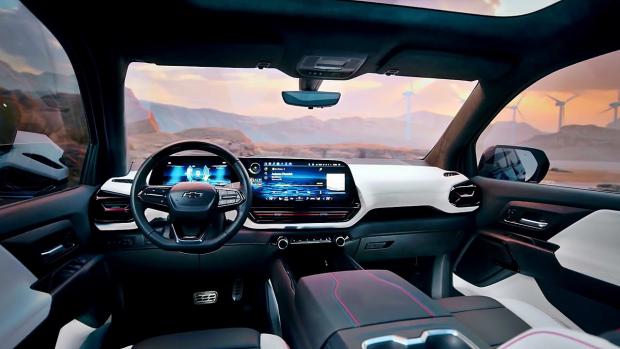
An engineering team within the Detroit automotive giant managed to push the single-charge EV range record into triple digits, beating out the ever-slippery Lucid Air GT sedan by over 300 miles (483 km) with the Silverado EV. A pickup truck.
As announced last October, the 2025 Silverado EV Max Range Work Truck (8WT) boasts an EPA-estimated range of 492 miles (792 km), shooting right past the Teslas and Rivians of the world to park comfortably behind the 516-mile (830-km) Lucid Air Grand S Touring at the tippity top of the US market range leader list. Its 68-mpg-e efficiency is far less impressive, but you can't call it a slouch when it comes to long-hauling on a single charge.
Well before Lucid's sedan had set its recent 749-mile (1,205-km) mark, itself a full 100 miles (161 km) farther than the previous record, some GM engineers began theorizing about how far the Silverado Max Range WT commercial pickup might actually go with a little bit of forethought and precise execution. Some voices among the group were particularly ambitious: 1,000 miles (1,609 km) didn't seem out of reach.
A proper challenge was formulated, and the team began driving a production Silverado MR WT to fine-tune their hypermiling strategies.
"Getting this kind of range on a full charge doesn't happen by accident," explained Kurt Kelty, GM VP of battery, propulsion and sustainability. "It takes deep integration across battery chemistry, drive unit efficiency, software and vehicle engineering."
Each engineer brought in his or her own expertise when developing driving strategies, and the team quickly dialed in a holistic game plan. Some of the strategies were fairly obvious mileage-boosting techniques and/or luxuries available to an engineering team that might not be available to an everyday driver. For instance, the driver was mostly alone to cut out the additional weight of passengers, and the truck's spare tire was left behind to further slash weight.
Heavily modifying the vehicle would have gone completely against the spirit of the challenge, but the team did make some slight alterations that stayed within the letter of the user manual. They inflated all tires to the highest recommended pressure to cut rolling resistance, fine-tuned the wheel alignment for optimal performance, and set the windshield wipers as low as possible to minimize drag. They also added a tonneau cover over the bed for smoother airflow.
The timing of the feat was no coincidence, either, as the Michigan summer afforded the best possible ambient conditions for battery performance. It didn't, however, provide the best possible ambient conditions for driving around with no A/C whatsoever – GM's team took one for science and left the climate control off for the duration of the driving mission.