










Breaking News
 Still Discriminating
 Nike CEO may have just admitted the company went too woke as stock hits 12-year low
 Will Europe Be Annihilated Over Kaliningrad?
 The Last Asset--You Will Own Nothing
Top Tech News
 Most artificial limbs rely on silicone or plastic to mimic human hands.
 Flying cell tower beams phone signal to Japan from 10 miles up
 Chinese Commercial Reactor Achieves Nuclear Fusion with Clean Hydrogen-Boron Fuel
 Med Beds Just Took a MASSIVE Step Forward, Healing People in Days!
 Palmer Luckey: Autonomous Weapons Are Ancient and Why Anduril Won't Build Humanoids | EP #295
 A laser just photographed objects through six feet of concrete
 Elon Musk's Next-Gen Motor Destroy Entire EV Industry
 China's disputed satellite refueling heralds new space war era
 BYD Will Put Solid-State Batteries In An EV Next Year: Executive
 FDA-cleared exoskeleton puts spinal-cord patients back on their feet



3 Best Flexible Solar Panels (2022)
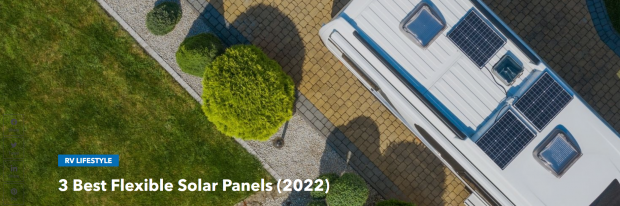
Table of Contents show
If you're thinking about getting solar power for your RV, camper van, or trailer, then consider a flexible solar panel. They are a little more forgiving than rigid solar panels, and are very convenient for the RV lifestyle!
In a recent podcast interview with Matt Foxcroft about RV innovations, we mentioned that running over a pothole in an RV is like going through a near 5.0 earthquake. That's why some people opt for flexible over rigid solar panels.
While flexible panels may not be quite as efficient as a traditional solar panel, they still offer high efficiency and excellent power output.
The following outlines what to look for in the best flexible solar panels, and my top choices on the market today!
We use affiliate links and may receive a small commission on purchases. Thank you for your support.
Flexible Solar Panels vs. Traditional Panels
The main difference between traditional rigid panels and flexible panels is (surprise, surprise) the flexible nature of the panels.
Flexible solar panels can be used in a wide range of applications. There are different installations that flexible panels are well-suited, such as being installed on uneven surfaces. That makes them great for recreational vehicles and camper vans!
Flexible panels are also lightweight, durable, portable, and relatively low cost!
They are also semi-transparent, meaning that they can be installed on glass or as a window.
While flexible solar panels have many benefits, there are some disadvantages of flexible solar panels as well. Traditional solar panels are more efficient than their flexible counterparts. A standard solar panel is better at converting sunlight into solar energy than panels with a curved surface.