










Breaking News
 They Couldn't Afford Compost… So Woodchips Saved This Garden
 Stop Poisoning Your Soil: It's Worse Than You Think!
 The Economist Who Called 2008 Says The Debt Crisis Warning Is A Myth -- We Had To React
 The 'Projects' That Could Ignite The Next World War
Top Tech News
 Anthropic is launching its own drug discovery programs for rare diseases using Claude...
 SpaceX AI Satellites Will Have 250 Kilowatts of Power
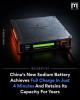 Chinese researchers have developed a sodium-metal battery that can fully charge in just 4 minutes...
 SpaceX Starship Flight 13 in 3 Days - Thursday July 13
 Chinese Scientists Develop Nuclear Battery Using Carbon-14
 Teleoperated humanoid robots complete first-ever live surgery
 Floating capsule auto-disinfects water without chemicals or battery
 Modular Reactors To Solve Data Center Hysteria?
 DeepSeek Developing In-House AI Chip In Bid To Cut Nvidia Reliance
 America just took three brand-new nuclear reactors critical in thirty days, a first for any...



China Unveils Quantim Chip 1 Quadrillion Times Faster Than The World's Top Supercomputer
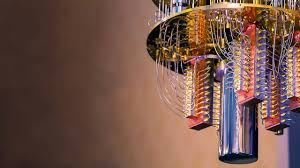
A research team at the University of Science and Technology of China (USTC) developed a quantum computing prototype that provides better performance than all existing supercomputers. The superconducting quantum processor Zuchongzhi-3 operates at a speed one million times faster than Google's Sycamore quantum processor, which had established the benchmark for quantum computing.
Zuchongzhi-3 achieves its high computational speed through its combination of 105 qubits and 182 couplers. Zuchongzhi-3 surpasses Google's Sycamore quantum processor because it contains 105 qubits while Sycamore only had 67 qubits. Random quantum circuit sampling tasks provided the proof of this breakthrough because they represent a standard evaluation method for quantum system performance. The sharp development of quantum computing technology focuses on developing devices that can handle supercomputing tasks that classical machines need years to finish. The United States and China lead an intense competition to control quantum technology, while China currently holds the lead position.