










Breaking News
 The Deep State's Get-Out-Of-Jail-Free Card
Why Not Stop Mass Immigration into the United States?
 French President Macron's Popularity Falls to Record Low of 16 Per Cent
 Top Signs You're Heading for a Quagmire
Top Tech News
 NASA Super Light Solar Sail Project Will Be 12-40 Times Lighter and Faster
 Space Telescope Interferometer to Image Exoplanet Continents
 Twenty-five years of "temporary": how 9/11 built a surveillance state Americans never vote
 I'll Never Buy Another WALMART Battery!
 Shoei GT-Air 3 Smart helmet drops with built-in AR for $1,500
 Freezable titanium plate keeps your cooler chilled way longer than ice packs
 Review: Affordable thermal device is made for discovering life outdoors
 AI Whistleblower Tells Tucker How AI Could Kill All Humans by 2040
 You Hate Flock? Well There's More...
 Will Spiking Diesel Prices Drive Autonomous Trucking?



Watch: Jetson's One Aircraft Just Competed in the First eVTOL Race
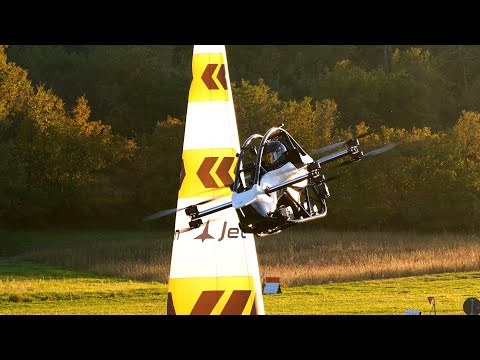
Jetson founder and CTO Tomasz Patan, who also designed the Volonaut Airbike and chief pilot Andrea Spresian were the other members who flew their Jetsons around a "racetrack" of large orange pylons. CEO D'haene flew the company's first production unit, the SN1, while Patan and Spresian flew pre-production units. "This event is a testament to the hard work and dedication of our team, and it paves the way for exciting developments in the future of urban air mobility," said D'haene in a statement. Jetson thinks that competitive racing could be an attractive pastime for new owners.
The Jetson C-Suite each kept their aircraft at a respectable distance without lapping each other, but showed how fun the one-person craft looks as it tilted, swerved, and turned tightly around the orange cones. With Italy's Tuscany region bathed in golden light, the race looked like a cross between a Star Wars speeder race and students on broomsticks at Hogwarts.
Jetson is one of multiple one-person eVTOL makers that hope to capture a share of a recreational aircraft market that does not yet exist. The FAA requires that any aircraft under its Part 103 be lightweight (the Jetson is 253 pounds with batteries) and that it can't fly near populated areas. One of Jetson's competitors, Pivotal, has begun to commercially sell its one-person Helix, which has a longer fuselage shape than the more squat, dune-buggy look of the Jetson, and the Helix cockpit is enclosed.
Jetson released a video last month showing one of its first production aircraft flights, after about five years of development. The mini-aircraft has an aluminum frame with carbon-fiber body panels. Eight rotors, powered by 8 electric motors, are mounted on four arms. The unit incorporates a triple-redundant computer system, with fly-by-wire controls for auto-landing and a ballistic parachute. Its top speed is 63 mph and range is a maximum of 20 minutes.