










Breaking News
 Charlie's Killer Was MKUltra'd?
 Doctors are finally admitting that biopsies Spread Cancer…
 We MUST keep talking about this, demand Voter ID. Joe Rogan and Elon Musk on Fraud
 Nick Shirley exposes there are 1,200 medical transport companies in Minnesota.
Top Tech News
 The First Production All-Solid-State Battery Is Here, And It Promises 5-Minute Charging
 See inside the tech-topia cities billionaires are betting big on developing...
 Storage doesn't get much cheaper than this
 Laser weapons go mobile on US Army small vehicles
 EngineAI T800: Born to Disrupt! #EngineAI #robotics #newtechnology #newproduct
 This Silicon Anode Breakthrough Could Mark A Turning Point For EV Batteries [Update]
 Travel gadget promises to dry and iron your clothes – totally hands-free
 Perfect Aircrete, Kitchen Ingredients.
 Futuristic pixel-raising display lets you feel what's onscreen
 Cutting-Edge Facility Generates Pure Water and Hydrogen Fuel from Seawater for Mere Pennies



Silver is not "running hot" by accident.
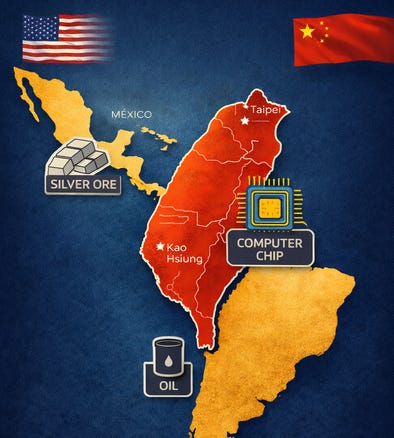
Overview: Silver's recent price behavior reflects geopolitical stress rather than speculation. It links contested Latin American supply chains, China's diplomatic strategy, and UN alignment to Taiwan as a core flashpoint risk, showing how material access, diplomacy, and institutional power reinforce each other amid rising U.S.–China rivalry. Part 1 here.
The recent behavior of silver is not best understood as a speculative episode or a narrow industrial imbalance. It is better interpreted as a market signal emerging from a broader geopolitical contest over supply chains, diplomatic alignment, and institutional control. That contest is increasingly centered on Latin America and the Caribbean (LAC), a region that has become strategic terrain in the evolving rivalry between China and the United States.
This is about how states behave when they perceive a core interest to be non-negotiable. The world is awash in existential threats, or at least perceived to be in economic and sovereign terms for the future as far as certain resources are concerend
Latin America as Strategic Terrain
Recent reporting by The Wall Street Journal has highlighted China's efforts to preserve and deepen its access to Latin American supply chains as U.S. policy shifts toward tighter economic and security alignment in the Western Hemisphere. The Journal frames Latin America as a core market for Beijing, but as a region whose alignment affects access to raw materials, ports, infrastructure, and trade routes at a time when globalization is fragmenting under security pressures.¹
That framing aligns closely with Beijing's own strategic messaging.
China's Policy Paper on LATAM and Taiwan Hardens
In December 2025, China released its third policy paper on Latin America and the Caribbean, following similar documents in 2008 and 2016. The document is notably expansive and structured in a way that places political alignment ahead of economic cooperation. While development, trade, and infrastructure feature prominently, they are presented as instruments rather than endpoints. Respect for China's "core interests" is explicitly identified as foundational to deeper engagement.² Read full story
This sequencing is deliberate. It reflects a strategic prioritization that becomes clearer when viewed alongside contemporaneous Chinese commentary.
Taiwan as the Flashpoint Risk
Within Chinese strategic doctrine, the one-China principle is treated as a red line. Taiwan is framed as a matter of sovereignty, legitimacy, and regime security. Beijing's objective is not limited to territorial reunification in the abstract. It is to ensure that no durable international legal or multilateral framework emerges that could constrain China's freedom of action in the future.