










Breaking News
 Ex-CIA Agent Speaks Out: JFK, 9-11, UAPs, MLK, MKUltra & Everything Trump Is Hiding
 China takes satellite race with SpaceX to sea
 The Low-T Issue
 Tesla Cybercabs and Superchargers Will Act as Mini Cell Towers for SpaceX Starlink
Top Tech News
 Elon Vows AI-Made 'Odyssey' After Blasting Nolan's Take On Homer
 Anthropic is launching its own drug discovery programs for rare diseases using Claude...
 SpaceX AI Satellites Will Have 250 Kilowatts of Power
 Chinese researchers have developed a sodium-metal battery that can fully charge in just 4 minutes...
 SpaceX Starship Flight 13 in 3 Days - Thursday July 13
 Chinese Scientists Develop Nuclear Battery Using Carbon-14
 Teleoperated humanoid robots complete first-ever live surgery
 Floating capsule auto-disinfects water without chemicals or battery
 Modular Reactors To Solve Data Center Hysteria?
 DeepSeek Developing In-House AI Chip In Bid To Cut Nvidia Reliance



The World's First Sodium-Ion Battery EV Is A Winter Range Monster
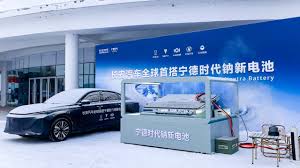
Chinese battery giant CATL and automaker Changan Automobile are preparing to put the world's first passenger car powered by sodium-ion batteries on public roads by mid-2026. And if the launch is successful, it could usher in an era where electric vehicles present less of a fire risk and can better handle extreme temperatures.
?
The CATL Naxtra sodium-ion battery will debut in the Changan Nevo A06 sedan, delivering an estimated range of around 400 kilometers (249 miles) on the China Light-Duty Test Cycle. From there, the battery will roll out across Changan's broader portfolio, including EVs from Avatr, Deepal, Qiyuan and Uni, the company said.
?"The launch represents a major step in the industry's transition toward a dual-chemistry ecosystem, where sodium-ion and lithium-ion batteries complement each other to meet diverse customer needs," CATL said in a press release.
It's a meaningful step forward for the technology that's rapidly emerging as an alternative to lithium-iron phosphate (LFP) batteries, which currently dominate China's EV market. Studies show that sodium-ion batteries carry no risk of thermal runaway and are far less sensitive to extreme temperatures. Above all, sodium is significantly cheaper and far more abundant than lithium.
?From an energy density standpoint, the Naxtra battery is competitive but not revolutionary. It delivers 175 watt-hours per kilogram of energy density, which is lower than nickel-rich chemistries but roughly on par with LFP. That makes it more suitable for low-cost and low-range EVs as well as stationary energy storage.
?
By using a cell-to-pack design, where individual cells are integrated directly into the battery pack instead of modules, CATL was able to extract 400 kilometers (249 miles) of range on the CTLC cycle.
But CATL says there's plenty of room for improvement on the range front. As the sodium-ion supply chain matures, the company expects EV range to climb to 600 kilometers (373 miles), while extended-range EVs (EREVs) and hybrids could reach up to 400 kilometers (249 miles). That would cover more than half of the typical range requirements in China's EV market, CATL claims.
?
Where the Naxtra battery really stands out, however, is cold-weather performance. CATL says its discharge power at -30 degrees Celsius (-22 degrees Fahrenheit) is three times higher than that of LFP batteries.
Unlike LFP or nickel-manganese-cobalt (NMC) packs, it reportedly avoids severe winter range loss, retaining more than 90% of its range at -40 degrees C (-40 degrees F). Power delivery is also said to remain stable at temperatures as low as -50 degrees C (-58 degrees F).