










Breaking News
 Since everyone is pocket watching, here's Nick on having his assets frozen by the federal...
 Why Is Trump So Desperate To Secure The Strait of Hormuz?
 With Foad Yesterday
 Dow Jones Adds and Removes Companies 20 Years too Late
Top Tech News
 Researchers Turn Car Battery Acid and Plastic Waste into Clean Hydrogen and New Plastic
 'Spin-flip' system pushes solar cell energy conversion efficiency past 100%
 A Startup Has Been Quietly Pitching Cloned Human Bodies to Transfer Your Brain Into
 DEYE 215kWh LiFePO4 + 125,000W Inverter + 200,000W MPPT = Run A Factory Offgrid!!
 China's Unitree Unveils Robot With "Human-Like Physique" That Can Outrun Most People
 This $200 Black Shaft Air Conditions Your Home For Free Forever -- Why Is It Banned in the U.S.?
 Engineers have developed a material capable of self-repairing more than 1,000 times,...
 They bypassed the eye entirely.
 The Most Dangerous Race on Earth Isn't Nuclear - It's Quantum.
 This Plasma Stove Cooks Hotter Than The Sun


The silent submarine hunter that could reshape future naval warfare
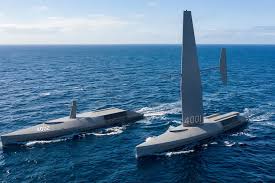
It may seem odd for a company that builds vessels propelled by the wind and solar energy for research to suddenly shift gears and get into submarine warfare, but if you look at the current trends in naval strategy it begins to make a lot of sense.
The days when a seafaring nation could rely on a blue-water fleet of major combat ships numbering less than one or two hundred hulls is over. The fleets of the future will be much larger and will be composed of a mix of crewed and autonomous craft designed to patrol far vaster areas than today. That means a lot of small robotic craft will be taking up the slack, leaving the conventional warships for more important duties.
Long-range sub-hunting is ideally suited for an autonomous sailcraft. Sailboats are notoriously quiet and their hulls are often acoustically transparent. In other words, they don't show up on sonar very well – if at all. It's for this reason that there are occasional news stories of submarines surfacing only to collide with small yachts. An autonomous sailing ship towing acoustic sensors would be, in theory, an excellent platform for detecting and tracking submarines.
With this in mind, Saildrone has released its first images of the two variants of its Spectre high-speed Unmanned Surface Vehicle (USV). Based on the company's earlier vessels, the Spectre is made out of aluminum and is being built in partnership with Fincantieri Marinette Marine in Wisconsin, which claims to be able to produce five craft per year. Meanwhile, Saildrone has partnered with Lockheed Martin since October 2025 to integrate combat-proven systems into the Spectre, including the Mark 70 Vertical Launch System for missiles.
Both variants can operate over a range of 8,000 nm (9,200 miles, 14,800 km) and can carry up to 25 tonnes of payload in the form of two 40-ft standard shipping containers or the equivalent.
Where the variants differ is propulsion. The Spectre Silent Endurance relies mainly on its 140-ft (43-m) composite wing for extreme range and silent propulsion. Meanwhile, the Spectre Stealth Strike swaps out the wing for Caterpillar diesel engines that allow it to sprint at speeds up to 27 knots (31 mph, 50 km/h) or trawl silently at 12 knots (14 mph, 22 km/h) under electric power.
The Spectre has already been granted Approval in Principle by the American Bureau of Shipping, and the first prototype is expected to begin sea trials early next year.
"Spectre is the result of 25 years of continually pushing the boundaries of what's possible," said Richard Jenkins, Saildrone's founder and CEO. "A unique design evolved through the hard lessons of operational experience in the real world. Spectre is not a craft hurriedly readied to meet a particular RFP, but diligently evolved over multiple years to meet the operational requirements of our customers and fill critical capability gaps in the ASW domain."