










Breaking News
Is There a Way out of the Iran War?
 Yale Professor Defines Elderly Americans as the New Class Enemy
 SpaceX Will Buy Cursor
 Trump reclassifies marijuana in bold move angering some of his closest Republican allies
Top Tech News
 Researchers Turn Car Battery Acid and Plastic Waste into Clean Hydrogen and New Plastic
 'Spin-flip' system pushes solar cell energy conversion efficiency past 100%
 A Startup Has Been Quietly Pitching Cloned Human Bodies to Transfer Your Brain Into
 DEYE 215kWh LiFePO4 + 125,000W Inverter + 200,000W MPPT = Run A Factory Offgrid!!
 China's Unitree Unveils Robot With "Human-Like Physique" That Can Outrun Most People
 This $200 Black Shaft Air Conditions Your Home For Free Forever -- Why Is It Banned in the U.S.?
 Engineers have developed a material capable of self-repairing more than 1,000 times,...
 They bypassed the eye entirely.
 The Most Dangerous Race on Earth Isn't Nuclear - It's Quantum.
 This Plasma Stove Cooks Hotter Than The Sun


From Gaza To BRICS: The Revolt Against The Dollar Order
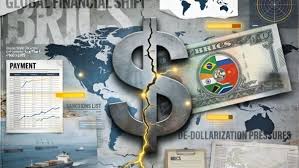
In practice, it became the armed currency of an imperial system that bombed states into ruin, sanctioned whole societies, and reserved the right to strangle any country that refused submission.
Unlike the usual churn of de-dollarization commentary, this report does not trade in fantasies of sudden dollar collapse or fairy tales about a BRICS currency descending to save the world overnight. It follows the machinery already taking shape beneath the noise, from national-currency trade and central bank swap lines to sovereign payment systems, digital settlement experiments, and BRICS-linked development finance, while keeping in view the fractures, delays, and contradictions that still run through the structure.
Just as important, this article refuses to separate economics from empire, tying the scramble for monetary sovereignty directly to sanctions, SWIFT weaponisation, the siege of Iran, and the wider coercive order that pushed much of the Global South to start building financial escape routes of its own.
The empire taught the world to flee
What matters here is not another recycled debate, but a grounded map of how a multipolar financial order is taking shape in practice, who is driving it, and why that shift now reaches far beyond the balance sheets of central banks.
That system is now producing its own backlash. Across BRICS and the wider Global South, de-dollarization is no longer a slogan tossed around at summits or a fantasy about a miracle currency waiting just beyond the horizon. It is taking material form through local-currency trade, sovereign payment systems, central bank swap lines, digital settlement projects, and development finance built to reduce exposure to Western-controlled capital.
The shift is not benign because it grows out of pressure, not theory. States that watched Russia cut from major Western financial channels, Iran suffocated under sanctions, and entire economies treated as hostages to US foreign policy have drawn the same conclusion. No nation can claim sovereignty if another power can freeze its trade, choke its banks, and police its payments.
That is why the war on Iran belongs at the heart of the story. The bombs may fall from the sky, but the same system works through banks, reserve currencies, settlement networks, and the threat of exclusion. Military aggression and monetary coercion are not separate instruments. They are two hands of the same order.
The scaffolding of a post-dollar order
A 2025 study on BRICS de-dollarization spearheaded by Podrugina Anastasia Viktorovna, an Associate Professor of the Department of World Economics, Faculty of World Economy and International Affairs, heading the Group for Structural Issues in the World Economy at the Centre for Comprehensive European and International Studies (CCEIS), makes clear that what is emerging is not a dramatic monetary rupture, but a layered architecture. Its pillars are already visible in the expansion of national-currency trade, the spread of central-bank swap arrangements, the growth of sovereign payment and messaging systems, the exploration of digital-currency settlement, and the gradual strengthening of financial markets in local currencies. The same study is sober enough to stress that this framework contains many of the necessary parts, but is still not fully functional.