










Breaking News
 No Benefits: Why Most Americans Hate The Idea Of AI Data Centers
 Are America's Youth Really Embracing Socialism?
 Are We About to See a Foreclosure WAVE Hit the US Housing Market?
 They Rolled Out the Relics - Then Cut the Working-Lands Money
Top Tech News
 World's smallest CT scanner fits in the palm of your hand
 The Tesla Roadster will blow people's minds
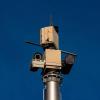 Peter Thiel-Funded Company Anduril to Triple the Number of Autonomous Surveillance Towers...
 Quantum computing may soon become part of the microscope itself.
 Volkswagen Just Unveiled The Most Efficient EV Ever Tested
 NASA Super Light Solar Sail Project Will Be 12-40 Times Lighter and Faster
 Space Telescope Interferometer to Image Exoplanet Continents
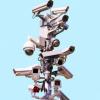 Twenty-five years of "temporary": how 9/11 built a surveillance state Americans never vote
 I'll Never Buy Another WALMART Battery!
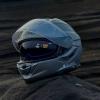 Shoei GT-Air 3 Smart helmet drops with built-in AR for $1,500



New Robot Ants Work Like Real Insects To Build And Dismantle On Their Own
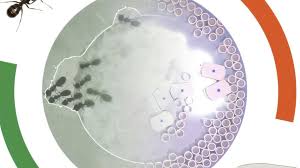
Dubbed "RAnts", these robotic ants have been designed by researchers from the John A. Paulson School of Engineering and Applied Sciences (SEAS).
These are simple, decentralized robots that can spontaneously organize to build — and just as easily destroy — complex structures.
Instead of chemical pheromones, these robots use light fields (photormones) to communicate.
"Our new study shows how simple, local rules can lead to the emergence of complex task completion that is self-organized and thus robust and adaptive," said Professor L. Mahadevan, the Lola England de Valpine Professor of Applied Mathematics, Organismic and Evolutionary Biology, and Physics at SEAS and FAS.
"We also introduce the concept of exbodied intelligence, where collective cognition arises not solely from individual agents, but from their ongoing interaction with an evolving environment," Mahadevan added.
Digital pheromones
Ants prove that you don't need a big brain to be a great builder. All that is needed is a great team. Without blueprints or supervisors, these tiny creatures construct some of nature's most complex habitats.
And now, experts are taking this cue. In recent years, AI development has obsessed over faster chips and bigger digital brains.
But Professor L. Mahadevan and his team looked elsewhere, particularly exbodied intelligence.
In this model, the smart systems aren't located inside the robot's hardware. Rather, the intelligence emerges from the interaction between the robot and its surroundings.
This study demonstrates that decentralized agents can achieve complex goals by following minimal physical rules and responding to environmental cues.
In the wild, ants communicate via pheromones — chemical breadcrumbs that signal where to walk or where to dig. To replicate this, the Harvard team used photormones.
Using a biological concept called stigmergy, in which individuals respond to environmental changes made by others, the team created "RAnts" that communicate through light fields known as photormones.
These digital signals act as a substitute for natural pheromones, allowing the robots to coordinate their actions by sensing and modifying their surroundings in a continuous feedback loop.