










Breaking News
 Saudi Arabia Vs UAE
 Trump Mulls Restart Of 'Project Freedom' As Gulf States Lift Military Curbs, Iran Reiterates
 Tucker & Thomas Massie on the Epstein Coverup and Israel's Influence on American Politics
 Trump Again Negotiates by Demanding Unconditional Surrender, TACO or War?
Top Tech News
 Wow. Researchers just built an AI that can control your body...
 Google Chrome silently installs a 4 GB AI model on your device without consent
 The $5 Battery That Never Dies - Edison Buried This 100 Years Ago
 That is not a real fish. IT'S A ROBOT.
 Scientists Unveil Hemp Alternative to Plastic That Can Withstand Boiling Water...
 A Robot Economy: Who Gets Rich, Who Gets Left Behind
 Is Surveillance Pricing Ripping You Off? How to Stop Your Data from Being Used Against You
 Robot Dives 1.5 Miles, Maps French Shipwreck With 86,000 Images And Recovers Artifacts
 Brain-inspired chip could reduce AI energy use by 70%
 CANCER HAS BEEN CURED


Hormuz crisis heats up Asia's Arctic scramble
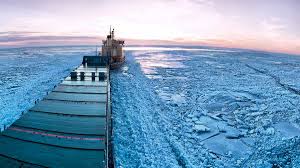
The Strait of Hormuz crisis will be remembered for many things, but its most consequential legacy may be one that has barely entered the public debate. It has accelerated Asia's geographic pivot away from the Middle East and toward a region most Asian capitals have until now treated as peripheral: the Arctic.
When the Oman-flagged tanker Voyager arrived in Imabari carrying Russian crude on May 5, the symbolism was read narrowly, as Japan grasping for emergency supply during the Gulf disruption. The geographic implication, however, was larger. The tanker did not come from the Middle East.
It did not transit through Hormuz, the South China Sea or any of the chokepoints that have defined Asian maritime security for half a century. It came from Sakhalin, in Russia's Far North. And the route it represents is the leading edge of a structural transformation that has been building quietly for a decade and is now being rapidly accelerated.
Consider what the Hormuz crisis has actually exposed. Asian economies were importing, on average, more than 80% of their crude through a single 33-kilometer chokepoint controlled politically by an actor capable of denying transit at will, and physically by a coalition whose own conflict with that actor provided the trigger.
The structural lesson is not that Asian buyers must diversify within the Gulf. The lesson is that the entire Middle East-centered architecture of Asian energy security was built on a geopolitical foundation the region does not control and cannot defend. That foundation has now publicly cracked.
Japan internalized this earlier than most of its neighbors. Tokyo's 2018 Third Basic Plan on Ocean Policy explicitly incorporated the Arctic into Japanese strategy, identifying the region as critical for maintaining a free and open maritime order based on the rule of law. This language entered Japanese policy three years before Indo-Pacific became fashionable diplomatic vocabulary, and eight years before Hormuz closed.
Japan's investment in Sakhalin-1 and Sakhalin-2, major hydrocarbon projects in Russia's Far East, was one node in a deliberate northern strategy that already includes the Northern Sea Route, sustained Arctic research programs and the Maritime Self-Defense Force's first Arctic deployment in 2020.
The Northern Sea Route, running along Russia's Arctic coast, shortens shipping distances between Asia and Europe by 36% to 40%, roughly 7,200 kilometers, relative to the Suez–Hormuz corridor.
In 2025, the route recorded 103 transit voyages by 88 unique vessels carrying about 3.2 million tons of cargo. These remain small numbers in global terms, but the trajectory is unmistakable.
The Arctic is becoming a viable commercial corridor faster than its skeptics anticipated, partly because climate change is melting it open and partly because Hormuz has made it indispensable.