










Breaking News
 New Study Says Grain Beats Grass: Joel Salatin Responds
 Stop Paying for Concrete - This Japanese Method Turns Plain Sand Into Solid Stone
 Solar Panels Plus Farming? Agrivoltaics Explained
 Cool knot techniques
Top Tech News
 I Built a Website to Expose Solar and Battery Scams
 Whistleblower Issues Dire Warning: Rogue AI, Hacking Nuclear Programs...
 Multi-material insulation delivers up to 10,000 x the stiffness
 Anduril's plan to save US sub edge from China's undersea surge
 Researchers Develop AI 'Mind-Reading' Tool That Reconstructs What Your Eyes See
 Video: Dexterous robot hand learns the delicate art of silk embroidery
 The computer that can read your mind:
 Seven apps. One craft
 SHOCK CASE REPORT: Advanced Alzheimer's Patient Regains Speech, Memory, Mobility...
 Most artificial limbs rely on silicone or plastic to mimic human hands.



Why Did We Stop Using Salt To Cool Our Homes?
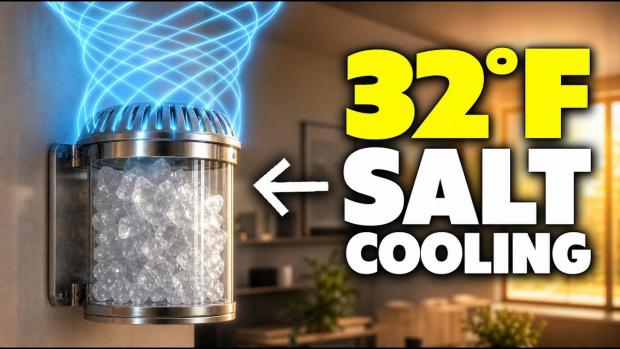
Salt was one of the most important cooling tools in human history. Long before refrigeration, salt preserved food, created ice in the desert, and chilled entire underground storage rooms to temperatures that kept meat and dairy fresh for months. Civilizations from ancient China to colonial America built entire industries around salt's ability to manipulate temperature. Then mechanical cooling arrived and salt went back to being a seasoning.In this video, we look at the many ways salt was used to cool homes, preserve food, and manage temperature — and why all of that knowledge was abandoned in less than fifty years.We start with the basics. Salt interacts with water and ice in ways that no other cheap, abundant material can. It lowers the freezing point of water, drives endothermic reactions that pull heat out of the surrounding environment, and absorbs moisture from the air. Each of these properties was exploited independently by different cultures across different centuries to solve the same fundamental problem — keeping things cool without electricity.We cover the major applications. Frigorific mixtures — salt and ice combined to reach temperatures well below freezing — were the basis of food preservation, early medicine, and commercial ice cream production for centuries. Salt-packed ice houses stored winter ice through entire summers, keeping estates, hospitals, and markets supplied with cold storage year-round. In arid climates, hygroscopic salts were used to pull moisture from the air, creating drier and more comfortable indoor environments through passive dehumidification. And in parts of the Middle East and North Africa, salt evaporation pools were paired with ventilation systems that used the cooling effect of evaporation to chill incoming air flowing over brine channels.We trace how salt cooling scaled into industry.