










Breaking News
 Pathway To Citizenship For DACA? Trump Directs DHS Chief To 'Work With Democrats'...
 Department Of Labor Floats Stricter Rules For Unemployment Benefits
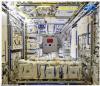 Baby it's cold INSIDE! Scientists create the coldest temperature ever recorded in the lab...
 Dark horse Jim Jordan beats establishment pick Steve Scalise to lead House GOP after promising...
Top Tech News
 Musk's Starlink Is Building An Orbital Bypass As Undersea Cable Sabotage Threats Mount
 A robot just built a structure in space for the first time
 The Greatest Theft in Human History
 3D-Printed Tungsten Survives 74 Fusion Plasma Discharges, Advancing the Engineering...
 Dude turns a $23 used smartphone into the 4G brain of an RC aircraft.
 China's World-Beating Supercar Just Hit 312 MPH
 Pentagon Delivers 25,000+ Drones And Counter-Drone Systems To CENTCOM In A "Massive Surge"
 Prism puts an eye-controlled Linux computer on your face
 Remember Yesterday: AI For Today and Tomorrow
 Robot Mowers Invade America's Golf Courses, Putting Groundskeepers On Notice



Baby it's cold INSIDE! Scientists create the coldest temperature ever recorded in the lab...
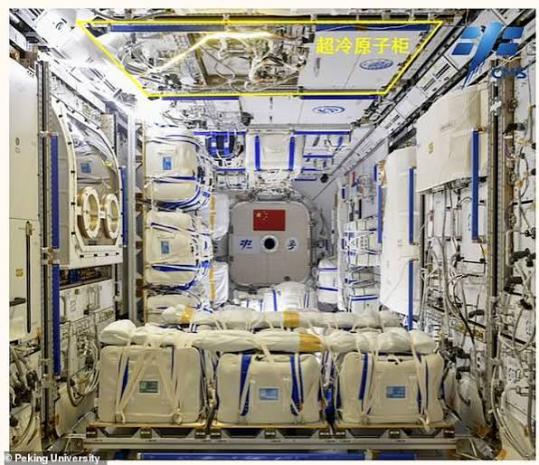
Scientists aboard China's Tiangong space station have chilled a cloud of atoms to just 9.7 picokelvin, the coldest temperature ever measured.
The record-breaking experiment took advantage of the station's microgravity environment, allowing researchers to study matter at temperatures closer to absolute zero than ever before.
The atoms were chilled to just 9.7 trillionths of a degree above absolute zero, around 280 billion times colder than the average temperature of the Universe.
The feat smashes the previous record of 38 picokelvin, which was achieved in a microgravity experiment on Earth in 2021.
Researchers say the breakthrough opens a new frontier in the quest to understand the strangest laws of quantum physics.
'This record-low temperature could stimulate a new generation of…experiments in quantum simulation and precision measurements in space,' the team, from Peking University and the Chinese Academy of Sciences, wrote in the journal Science.
The experiment was carried out using the Cold Atom Physics Rack housed inside the Mengtian laboratory module of China's orbiting space station.
The weightless environment of space was crucial because gravity on Earth makes it harder to keep ultracold atoms stable for long periods.
Inside the facility, scientists trapped about 20,000 rubidium atoms and cooled them until they formed an exotic state of matter known as a Bose-Einstein condensate.
This bizarre state occurs when atoms become so cold that they begin behaving like a single giant quantum object.
To push temperatures even lower, the team transferred the atoms into a trap made of laser light and allowed them to expand under carefully controlled conditions.
The researchers were able to observe the freezing cloud of atoms for an extraordinary seven seconds as it expanded freely.