










Breaking News
 The TERRIFYING Reason Peter Thiel Escaped the US
 Professor Jiang Breaks Down the Greater Israel Project
 Edward Snowden on Palestine and Sam Altman
 Palantir. IT'S WORSE Than You Think
Top Tech News
 Solar Panels Are Doing Something Nobody Expected
 DeLorean climbs skyward to race electric flying cars
 Atari's 800XL returns with a keyboard, cartridges and BASIC
 Bioinspired robot airdrops into remote waters via morphing wing-sail
 Anduril interceptor adapts to emerging threats via swappable stages
 I Built a Website to Expose Solar and Battery Scams
 Whistleblower Issues Dire Warning: Rogue AI, Hacking Nuclear Programs...
 Multi-material insulation delivers up to 10,000 x the stiffness
 Anduril's plan to save US sub edge from China's undersea surge
 Researchers Develop AI 'Mind-Reading' Tool That Reconstructs What Your Eyes See



Teleoperated humanoid robots complete first-ever live surgery
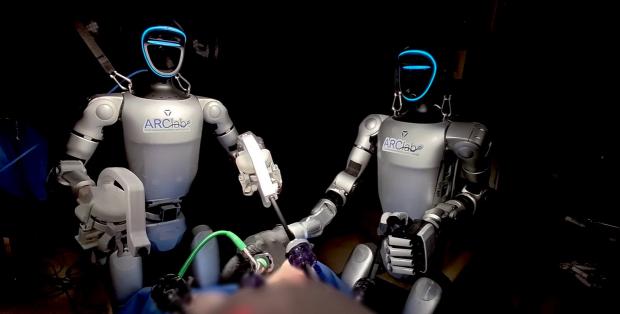
Surgeons at UC San Diego just handed the scalpel to two humanoid robots, who went on to complete live surgical procedures for the first time in history. This milestone moves beyond the fixed robotic arms found in operating rooms today and hints at an operating room of the future where humans and humanoids work side by side.
Humanoid robots are already showing up in factories, warehouses, and even on battlefields, precisely because their human-like shape lets them operate in spaces built for people without any redesign. A Morgan Stanley report from late June projects that China, the current leader in the field, will produce 446,000 humanoid units annually by 2030, with full-size humanoids growing from 30% market share in 2026 to 70% by 2028.
UC San Diego's team wants to bring that same flexibility into the operating room. In one procedure, a humanoid robot and a human surgeon acting as an assistant completed a cholecystectomy (gallbladder removal). In a second, two humanoid robots worked together and finished the operation solo.