










Breaking News
 S3E22: You Don't Own Your Stocks. The Tokenization Trap Is Here.
 A Discussion of Open-Source AI with Travis Oliphant (Full Interview)
 The Mall Is Scanning Your Plate -- And Owes You $2,500
 Baron Coleman: EVERYTHING that's wrong with the Tyler Robinson Charlie Kirk Story | Redacted New
Top Tech News
 Anthropic is launching its own drug discovery programs for rare diseases using Claude...
 SpaceX AI Satellites Will Have 250 Kilowatts of Power
 Chinese researchers have developed a sodium-metal battery that can fully charge in just 4 minutes...
 SpaceX Starship Flight 13 in 3 Days - Thursday July 13
 Chinese Scientists Develop Nuclear Battery Using Carbon-14
 Teleoperated humanoid robots complete first-ever live surgery
 Floating capsule auto-disinfects water without chemicals or battery
 Modular Reactors To Solve Data Center Hysteria?
 DeepSeek Developing In-House AI Chip In Bid To Cut Nvidia Reliance
 America just took three brand-new nuclear reactors critical in thirty days, a first for any...



Cheap Off-Grid Power: Real Solar Setups Under $1,000
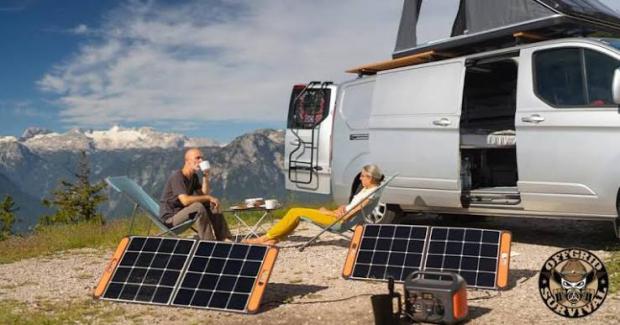
That world is gone. Panel prices collapsed, lithium batteries got cheap, and today $1,000 spent right will run a fridge, lights, a freezer, phones, a laptop, and a fan indefinitely, anywhere the sun shines. Spent wrong, that same $1,000 buys a pile of mismatched junk that dies the first winter. This article is the difference between the two.
I'm going to give you three real setups at three price points, with actual products you can order off Amazon today, and — more importantly — the math for sizing it yourself, because your power needs aren't mine.
One thing before we start, because this is the single biggest scam in the whole space: Amazon is crawling with no-name power stations claiming huge capacity for suspiciously little money. People who actually put meters on this stuff keep finding the same ugly pattern — boxes labeled "500Wh" that hold well under half that when measured, and "600W" inverters that trip out the moment you load them halfway. You're not saving money buying those, you're pre-buying a fire hazard and a disappointment. Stick to the established names — EcoFlow, Bluetti, Jackery, Anker, Goal Zero — or to known DIY component brands like Renogy and Victron. Every product I name below passes that bar.
First, the solar math you need to know
Skip this and you'll buy wrong. It takes five minutes.
Everything runs on watt-hours (Wh). A watt-hour is one watt for one hour. A 60W fan running 5 hours = 300Wh. That's the whole system: how many watt-hours do you burn per day, and how many can you make and store?
Walk your house and list what actually needs to run in an outage or a cabin. Real numbers for common gear:
Phone charge: 10-15Wh
Laptop: 50-60Wh per charge
LED bulb: 9W, so 45Wh for an evening
12V camping fridge: 40-60W running, roughly 500-700Wh per day
Full-size modern fridge: 1,000-1,500Wh per day
CPAP machine (no humidifier): 30-60W, call it 300-500Wh a night
TV: 60-100W
Starlink: 50-75W, so 1,200-1,800Wh if it runs all day
What you'll notice missing from that list: anything that makes heat. Space heaters, electric water heaters, electric stoves, hair dryers. Heat is the enemy of small solar — a single 1,500W space heater eats more in one hour than most of these systems store in total. Off-grid, heat comes from propane and wood, not from your battery. Accept that now and everything else gets easy.
Second number: what the sun gives you. The useful rule is "peak sun hours" — your location gets the equivalent of somewhere between 3 (Pacific Northwest winter) and 6+ (desert Southwest) hours of full-strength sun per day. Panel watts × sun hours × 0.75 for real-world losses = your daily harvest. A 400W array in average U.S. conditions produces roughly 2,000-2,500Wh per day — plenty for the fridge-lights-phones-laptop life.
Now the three builds.