










Breaking News
 Alex Hormozi's Warning: Stop Chasing AI, Build This Instead!
 What Happens to Your Body When You Eat One Meal a Day for 30 Days
 Young Middle-Income Buyers Frustrated As US Home Costs Rise Faster Than Incomes
 The Library of Alexandria is NOT on Fire
Top Tech News
 Elon Vows AI-Made 'Odyssey' After Blasting Nolan's Take On Homer
 Anthropic is launching its own drug discovery programs for rare diseases using Claude...
 SpaceX AI Satellites Will Have 250 Kilowatts of Power
 Chinese researchers have developed a sodium-metal battery that can fully charge in just 4 minutes...
 SpaceX Starship Flight 13 in 3 Days - Thursday July 13
 Chinese Scientists Develop Nuclear Battery Using Carbon-14
 Teleoperated humanoid robots complete first-ever live surgery
 Floating capsule auto-disinfects water without chemicals or battery
 Modular Reactors To Solve Data Center Hysteria?
 DeepSeek Developing In-House AI Chip In Bid To Cut Nvidia Reliance



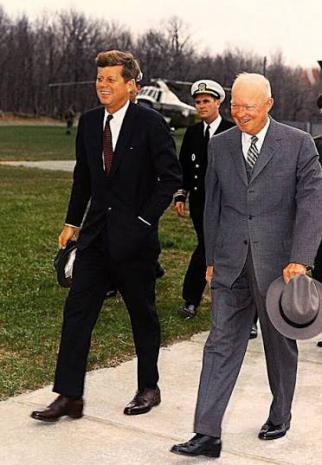
Ike and JFK Were Right … and It Matters Tremendously Today
This conjunction of an immense military establishment and a large arms industry is new in the American experience. . . .Yet we must not fail to comprehend its grave implications. . . . In the councils of government, we must guard against the acquisition of unwarranted influence, whether sought or unsought, by the military-industrial complex. The potential for the disastrous rise of misplaced power exists and will persist.
Ike was making two critically important points:
First, the military-industrial complex — or what is known today as the national-security state — was a relatively new governmental structure for the United States, one that came into existence after World War II and without even the semblance of a constitutional amendment.
America started out as a limited-government republic, which is a governmental structure that is totally different from a national-security state. It was a structure in which the federal government was small and weak. The powers of the federal government were limited to those few powers enumerated in the Constitution. To make sure federal officials got the point, the American people enacted the Bill of Rights, which expressly restricted the powers of federal officials.
Second, this new governmental structure to which Ike referred posed a grave threat to the freedom, well-being, and democratic processes of the American people. That's what Ike meant when he stated, "We must not fail to comprehend its grave implications."
The Framers and our 18th-century American ancestors shared Eisenhower's sentiments. They were fiercely opposed to "standing armies" because they were convinced that the biggest threat to people's freedom and well-being lay not with some foreign regime or foreign entity but rather with their very own government, especially one with an enormously powerful military establishment with the ability to impose its will on the citizenry.
In fact, if the Constitution had proposed a national-security state, there is no doubt whatsoever that our American ancestors would have rejected it, in which case the country would have continued operating under the Articles of Confederation, another type of governmental structure, one in which the federal government's powers were so weak that it didn't even have the power to tax.
Everything changed after World War II, when the federal government was converted into a national-security state as part of the old Cold War racket that was based on the ludicrous notion that there was an international communist conspiracy based in Moscow, Russia, one in which the Reds were supposedly coming to America and taking over the United States.
The federal government was now to be characterized by an enormous and ever-growing military-intelligence establishment, one composed of the Pentagon, a vast and permanent empire of domestic and foreign military bases, an army of voracious "defense" contractors, the CIA, and the NSA.