










Breaking News
 BEYOND THE MOON: NASA plans a nuclear-powered fleet to push DEEPER into space
 Defense Minister Says Pakistan Will 'Fulfill Our Duty' to Saudi Arabia Amid Attacks from Ans
 Now Even English Villages Want To Leave Britain
 The 'Clancy holdout juror' saga takes another WILD turn…
Top Tech News
 Terrifying AI Behavior Even Its Creators Couldn't Explain
 WW3 Near-Miss? AI Hallucinated Nuclear Weapons Components Aboard Chinese Vessel Bound For Iran
 Stripe Is Building the Toll Road for the Machine Economy
 Toyota Dakar hopeful swaps twin-turbo V6 for hydrogen fuel cells
 4-min turbo-inflatable cubic camp castle is now available in the USA
 Researchers Used Claude To Hack OpenAI Employee Accounts
 Chinese Scientists Develop New Oil Refining Method That Cuts Energy Use by 90%
 World's smallest CT scanner fits in the palm of your hand
 The Tesla Roadster will blow people's minds
 Peter Thiel-Funded Company Anduril to Triple the Number of Autonomous Surveillance Towers...



Hoover Dam is losing power. Inside the 'slowest-moving train wreck in history'
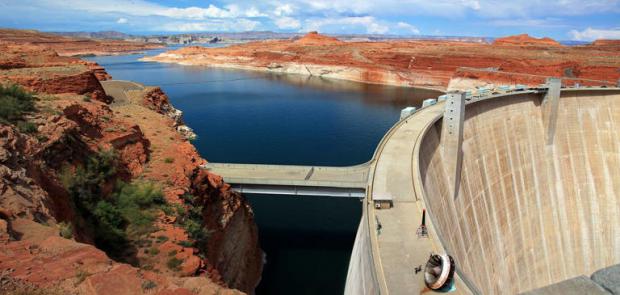
FROM THE RIM of Lake Powell, you can't see the danger line. There isn't a flashing gauge or a chart on the canyon wall that warns visitors when one of the most important machines in America begins to fail. There's only an invisible number: 3,490 feet above sea level.
Engineers call it "minimum power pool." Above that elevation, Lake Powell can still push water through Glen Canyon Dam's massive penstocks, spin its turbines, and send electricity across the Southwest with no trouble. Below it, the dam loses the function that helped justify its existence. The river still wants to move, but the machine starts running out of ways to move it.
Glen Canyon Dam and Lake Powell sit near the center of the Colorado River system, upstream from Hoover Dam and Lake Mead. Together those reservoirs store the water that cities, farms, and power plants across the Southwest depend on. Now the entire system is being pushed past its limits, and Lake Powell is where the cracks are really starting to show.
Since 2000, the Southwest has been caught in a megadrought that has steadily pulled down water levels in both Lake Powell and Lake Mead. Climate change has made that trend hotter, drier, and harder to reverse. In 2026, a punishingly weak snowpack and an extreme heat wave pushed the basin deeper into emergency. The Bureau of Reclamation began taking steps to keep Lake Powell's water levels high enough for electricity generation; Hoover Dam's hydropower output is expected to drop by 40 percent of its maximum capacity this year.
