










Breaking News
 Was the Garden of Eden God's Permanent Diet? The Answer Surprised Me
 The BDE Gets a Truck Driver's Approval
 U.S. Sailors Are JUMPING OVERBOARD To Escape Mideast Deployment!
 America is Just Days Away From Famine and We Aren't Prepared
Top Tech News
 The Lucid Cosmos Will Have More Range Than Any Tesla
 Strong 3D printable elastic polymer resists damage
 Double hydrogen-combustion car breaks world land speed record
 Vitalik Buterin Says Ethereum Is Betting Its Future On Quantum Security And AI
 Everything You Wanted To Know About Building A Cheap AI Setup (That Still Works)...
 If They Were Human, They'd Be Arrested. Experts Respond To Rogue AI Breaches
 Sodium Ion Batteries Will be 80% Cheaper & Last LONGER!
 German startup SAXON Q has introduced a diamond-based quantum computing system...
 Elon Musk To Build The Largest Building In The World - 100 Million Square Feet
 Bitcoin 'Red Team' Says AI Is Finding 100s Of Critical Exploits Across Core Projects



The Gold Tax Surprise: When Gold Profits Get Taxed At 28 Percent
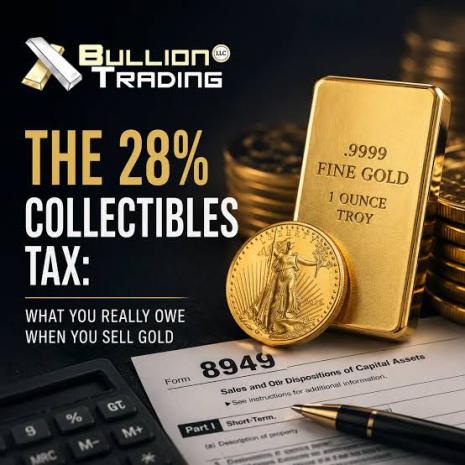
The IRS classifies physical gold, and even the popular bullion-backed gold exchange-traded funds (ETFs), as collectibles, a category shared with art, stamps, and antiques. That classification changes the tax bill when you sell. Most holders discover it at the worst possible moment: after the sale, when nothing can be done.
Here is the rule to understand before you sign anything.
Quick Answer: How Is Gold Taxed When You Sell?
Long-term gains on physical gold and bullion-backed ETFs are taxed as collectibles: at your ordinary income tax rate, capped at a maximum of 28 percent. That cap is the part many investors misunderstand and what a lot of media coverage gets wrong. If you are in the 12 percent bracket, you pay 12 percent, not 28 percent. The 28 percent figure only bites investors whose ordinary rate would otherwise be higher, and it compares unfavorably to the 15 or 20 percent long-term rates on gains on stocks.