










Breaking News
France's Immigration Party Coming to America: Faster Than You Think
A3Podcast 8 - Our Enemy, the State; Publishing and Accessing An IPFS Website; and more...
 Tuesday War Room LIVE – 'Let Us In': 1 Million Migrants Torch Italy As Trump Warns...
 The Fall of Saudi Arabia?
Top Tech News
 Solar Panels Are Doing Something Nobody Expected
 DeLorean climbs skyward to race electric flying cars
 Atari's 800XL returns with a keyboard, cartridges and BASIC
 Bioinspired robot airdrops into remote waters via morphing wing-sail
 Anduril interceptor adapts to emerging threats via swappable stages
 I Built a Website to Expose Solar and Battery Scams
 Whistleblower Issues Dire Warning: Rogue AI, Hacking Nuclear Programs...
 Multi-material insulation delivers up to 10,000 x the stiffness
 Anduril's plan to save US sub edge from China's undersea surge
 Researchers Develop AI 'Mind-Reading' Tool That Reconstructs What Your Eyes See



THEY ARE TRACKING THE ANIMALS THAT FEED US | Why?
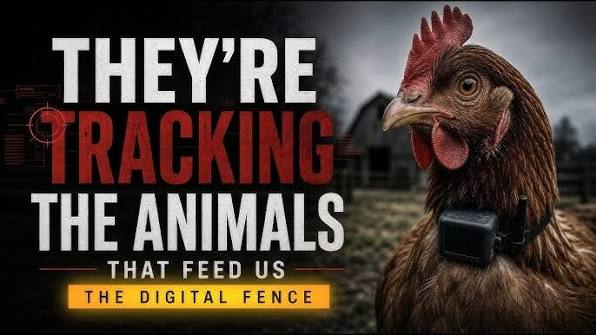
In England and Wales, owning even one backyard chicken now requires government registration. Australia is rolling out mandatory electronic tags for every sheep and goat. New Zealand already enforces a full national animal tracking system with real fines. And in the United States, electronic identification is becoming the new standard for cattle moving across state lines.
This is not a conspiracy theory.
This is documented policy.
In this investigation we examine the global expansion of livestock identification and traceability systems — from backyard poultry registration to electronic cattle tags and satellite monitoring of farmland. We look at the official justifications (disease control and biosecurity) and the capability these systems actually create: permanent, searchable records linking animals, people, locations, and movements.
We have the documents.
We have the timelines.
We have the enforcement examples.
The question is no longer whether these systems are being built.
The question is what else they can eventually be used for.
Watch the full investigation. Share it with anyone who keeps animals — or who simply cares where their food comes from.
Not opinions. Documents.