










Breaking News
 An Air Taxi Landing Site Is Coming to Downtown Los Angeles
 Special Guest: Bill Buppert
  They've Come for Your Tires, Too
 "All Accurate": Musk Confirms Massive New Starship Rocket Base In Louisiana
Top Tech News
 Portable 1MW Kaleidos Microreactor Secures Critical Nuclear Fuel Deal Through 2030s
 This New All-In-One Range Extender Is Ready To Go Into Any Electric Truck
 Aptera Reveals The Secret To Building Its Solar EV: China
 High-voltage sodium home battery emerges as affordable rooftop solar solution
 Peter Thiel-Funded Company Anduril to Triple the Number of Autonomous Surveillance...
 China has released Origin Pilot, claimed to be the world's first open-source operating system...
 ShieldAI XBAT Drone Fighters Can Give A Fighter Drone Wing to Every US Destroyer
 Brain organoids, kept alive more than five years, matured like human brains
 Parkinson's patient's tremors VANISH within minutes of GROUNDBREAKING treatment
 NEW HOMES ARE BUILT WITH THIS AND IT'S MAKING YOU SICK


Claude will now watermark all content generated using its tools
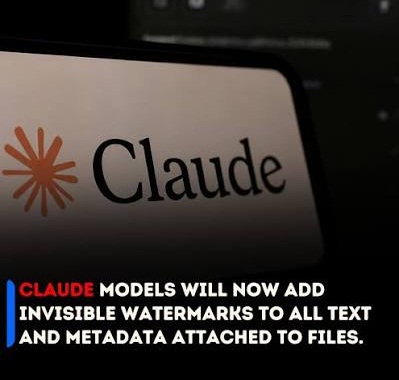
This figure doesn't account for offline documents. It also only covers text. Generative AI now produces music, illustrations, software, photographs and increasingly convincing video. The problem is that much of it is becoming difficult to distinguish from human-created work, raising transparency and security concerns.
The European Union's answer to these concerns is regulation. Under Article 50(2) of the EU AI Act, providers of generative AI systems are required to make all generated content detectable as artificially generated or manipulated.
Anthropic, the company behind Claude, has signed the bloc's Code of Practice on Transparency of AI-Generated Content, one of around 190 signatories, and now plans to watermark Claude's output across its ecosystem. According to the company, text will carry an invisible statistical watermark, while supported visual formats (such as PNG, JPG, or SVG) will receive signed metadata noting that Claude was involved.