










Breaking News
 Got Hard Assets? UBS Says "Position For A Commodity Upcycle" As Global Scarcity Emerges
 Moscow Warns It Could Target British Military Facilities In Unprecedented Statement
 Why Food-Based Formats Change Behavior
 PayPal Crashes After Advent, Stripe Abandon $50 Billion Takeover Bid
Top Tech News
 Singapore is experimenting with biological computing using living human neurons...
 It's Happening - Europe is Building an Impossible Fusion Reactor
 Portable 1MW Kaleidos Microreactor Secures Critical Nuclear Fuel Deal Through 2030s
 This New All-In-One Range Extender Is Ready To Go Into Any Electric Truck
 Aptera Reveals The Secret To Building Its Solar EV: China
 High-voltage sodium home battery emerges as affordable rooftop solar solution
 Peter Thiel-Funded Company Anduril to Triple the Number of Autonomous Surveillance...
 China has released Origin Pilot, claimed to be the world's first open-source operating system...
 ShieldAI XBAT Drone Fighters Can Give A Fighter Drone Wing to Every US Destroyer
 Brain organoids, kept alive more than five years, matured like human brains



THE CEUTA CROSSING: Anatomy of a Manufactured Crisis
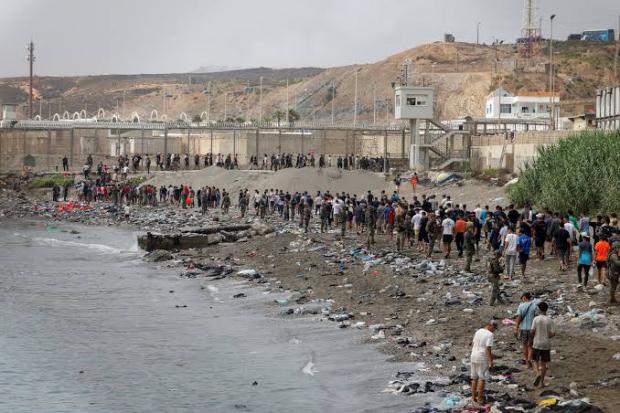
Tens of thousands of young men surged into Ceuta by land and sea, following online claims that the crossing had been opened. By morning, bodies were being pulled from the water and collected from the fence.
It looked like chaos, but it did not come without warning. For years, Israeli and American political figures had threatened Spain over Gaza, questioned its sovereignty in North Africa and presented Ceuta as a pressure point. Months before the crossing, a former Pentagon adviser published the method almost exactly as it later unfolded, calling on Morocco to send an unarmed mass march into the city while NATO stood aside.
This investigation follows the trail that preceded the crowd, through Israeli threats, Washington pressure, Moroccan lobbying, military agreements and a digital mobilisation that delivered tens of thousands of people to one of Spain's most exposed borders. The fence gave way only after powerful interests had spent years explaining exactly what Spain's loss of control over Ceuta could achieve.
On the night of July 29, 2026, an estimated 70,000 people, mostly young men, crossed from Morocco into the Spanish city of Ceuta in under forty-eight hours. At least 88 people died at the border fence, and in the water; a toll Spanish authorities and news organisations repeatedly revised upwards in the days that followed. Morocco's Interior Ministry put the figure at 11, while the Moroccan Association for Human Rights (AMDH) estimated that nearly 130 people had died. More than a thousand required medical treatment, yet days later there was still no agreed account of how many lives the crossing had taken.
Moroccan police were present along the route in visible numbers. Videos circulating within hours showed officers watching the crowds pass and, in some cases, appearing to direct people towards crossing points rather than stopping them. By the weekend, testimony published by international news organisations had made those images harder to dismiss. Several people who reached Ceuta said Moroccan officers had told them, "Go that way" or "Come to Spain." The force capable of stopping the movement was not absent. It was there, along the route, as tens of thousands advanced towards the border. That shifts the investigation away from how Morocco lost control of the crossing and towards the evidence that, for the crucial hours in which it gathered momentum, control was deliberately withheld.
Within a day, Spain's government said the situation had almost entirely reversed, with most of the crowd returning voluntarily to Morocco. According to Spanish Government Delegate in Ceuta Miguel Ángel Pérez Triano on 3 August 2026, approximately 2,500 irregular migrants remained in the city, a number that, based on Interior Ministry data, exceeded Ceuta's capacity to care for them.
The Spanish Interior Ministry credited Moroccan authorities with cooperating "faithfully and permanently" and with preventing the arrival of even larger numbers. Morocco's embassy in Madrid called the cooperation "exemplary." Unnamed Moroccan diplomatic sources told Euronews the same week that the assistance on the ground had actually been "limited and insufficient to contain the pressure." Both accounts referred to the same forty-eight hours, but they point in different directions.