










Breaking News
 Breaking: Milo Yiannopoulos Taken Into ICE Custody in Louisiana – Laura Loomer Takes Credit...
 JUST IN: Judge Declines to Block Trump's Executive Order Ending Birth Tourism
 FDA Approves 3 New COVID-19 Vaccines
 Trump Strikes "Biggest Oil Deal In History": US To Take Majority Stake In Over 65BN Barrel
Top Tech News
 Singapore is experimenting with biological computing using living human neurons...
 It's Happening - Europe is Building an Impossible Fusion Reactor
 Portable 1MW Kaleidos Microreactor Secures Critical Nuclear Fuel Deal Through 2030s
 This New All-In-One Range Extender Is Ready To Go Into Any Electric Truck
 Aptera Reveals The Secret To Building Its Solar EV: China
 High-voltage sodium home battery emerges as affordable rooftop solar solution
 Peter Thiel-Funded Company Anduril to Triple the Number of Autonomous Surveillance...
 China has released Origin Pilot, claimed to be the world's first open-source operating system...
 ShieldAI XBAT Drone Fighters Can Give A Fighter Drone Wing to Every US Destroyer
 Brain organoids, kept alive more than five years, matured like human brains



Bessent vs. Druckenmiller: Bond Vigilantes versus Bond Bureaucrats
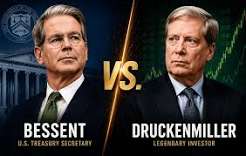
The dispute between Treasury Secretary Scott Bessent and Stanley Druckenmiller is more important than a technical disagreement over Treasury buybacks. It is a disagreement about what financial markets are for.
In one corner are the bond vigilantes: investors whose buying and selling impose a market price on fiscal profligacy, inflation risk, and deteriorating credibility. In the other are the bond bureaucrats: policymakers who increasingly regard adverse market prices as problems to be managed rather than information to be absorbed. Bessent increasingly appears to occupy the latter camp. Druckenmiller's position is considerably more market-oriented: rising long-term yields are information. They reflect the collective assessment of millions of global investors confronting inflation, fiscal policy, debt issuance, growth expectations, and political risk. Suppressing that signal does not eliminate the underlying problem. It merely interferes with the price mechanism communicating it.
The philosophical divide is increasingly clear: Druckenmiller sees markets as institutions through which participants express views and discover prices, while Bessent appears to regard the Treasury market, perhaps because it trades the government's own securities, as another avenue through which government policy may legitimately be conducted.
The immediate controversy concerns Treasury's decision to double the maximum size of long-duration bond buybacks from $2 billion to $4 billion after the 30-year yield reached its highest level in nearly two decades. Bessent has portrayed the intervention partly as a response to yields that he believes are inconsistent with economic fundamentals and has emphasized that Treasury has additional tools available. Druckenmiller sees something much more troubling. There was no failed auction, seizure in dealer balance sheets, or disorderly liquidation comparable with March 2020. Markets were functioning. Investors simply demanded higher yields. In Druckenmiller's formulation, this was not liquidity management but price management.
But even the distinction between "functioning" and "dysfunctional" markets should be treated cautiously. Governments and central banks have spent decades expanding the circumstances under which extraordinary volatility, widening spreads, falling asset prices, or rapidly rising yields are characterized as market failures requiring official action. Yet violent price movements are not necessarily evidence that markets have ceased functioning. They may instead be markets functioning particularly efficiently, rapidly incorporating information that policymakers, issuers, or leveraged investors would rather not confront. Once officials assume the authority to decide which prices constitute legitimate price discovery and which require correction, markets cease to be entirely markets. Prices become partly political decisions.
That is the deeper problem with Bessent's approach. If Treasury regards some yields as unacceptable, investors inevitably begin trying to determine where the government's pain threshold lies. The bond bureaucrats may therefore wind up summoning the very bond vigilantes they hope to suppress. Every implied ceiling becomes something the market can test, and every intervention provides additional information about how much political discomfort a particular price is causing.