










Breaking News
 EXCLUSIVE: A Vindicated Mike Lindell Issues An Emergency Warning
 Coming Soon! Joel Salatin's Polyface Farms Documentary (Trailer)
 Iran Spokesman Threatens FIRST STRIKE on U.S. Targets
 REPORT: Fauci Told Aide to Permanently Delete Emails About Gain-of-Function Research
Top Tech News
 Singapore is experimenting with biological computing using living human neurons...
 It's Happening - Europe is Building an Impossible Fusion Reactor
 Portable 1MW Kaleidos Microreactor Secures Critical Nuclear Fuel Deal Through 2030s
 This New All-In-One Range Extender Is Ready To Go Into Any Electric Truck
 Aptera Reveals The Secret To Building Its Solar EV: China
 High-voltage sodium home battery emerges as affordable rooftop solar solution
 Peter Thiel-Funded Company Anduril to Triple the Number of Autonomous Surveillance...
 China has released Origin Pilot, claimed to be the world's first open-source operating system...
 ShieldAI XBAT Drone Fighters Can Give A Fighter Drone Wing to Every US Destroyer
 Brain organoids, kept alive more than five years, matured like human brains



What Happened To The So-Called AI Job Apocalypse?
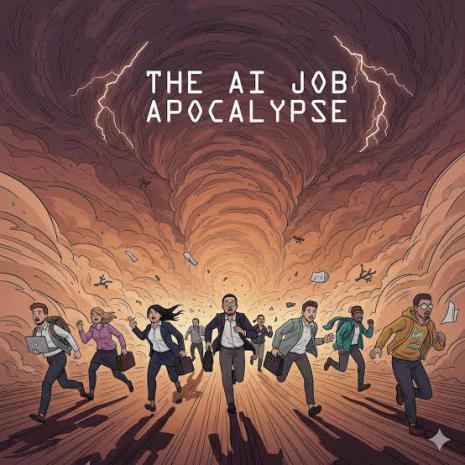
Meanwhile, new hiring data from the Economic Times reveals that AI is actively fueling unprecedented job creation, with AI skills now powering nearly two-thirds of new Global Capability Center hiring. Together, these recent dispatches from the front lines of the labor market point to a calming reality: the much-dreaded AI job apocalypse hasn't materialized as a sudden extinction event.
The (sometimes buried) lede: AI is delivering real impact, and it is broadly changing the nature of work. But disruption is not a new phenomenon. The economy has always dismantled old work to build new work. What determines whether this evolution feels like progress or collapse isn't just the number of jobs lost, it's the speed at which that loss hits the labor market.
In 1995, Bill Gates circulated a memo titled "The Internet Tidal Wave," calling the web the most important computing development since the IBM PC. If the internet was a tidal wave, artificial intelligence is a tsunami. It is arguably the biggest advancement in computing since the Turing machine. Yet, from a distance, it's difficult to appreciate the speed of this wave, leading many to wonder when the broader economy will truly feel its impact.
To put this in context, we must understand the historical pattern already visible in the labor market. Combining decades of data from the U.S. Bureau of Labor Statistics and the Federal Reserve yields a remarkably consistent story of overlapping curves: job loss and job creation. Over the last two decades, nearly 20 million U.S. jobs vanished in disrupted sectors. Over the same period, total payrolls grew by 25.7 million. That equates to roughly 1.3 new jobs for every one destroyed. Classic examples include jobs in video rentals (-98.9%) and word processing (-83%) which largely vanished, but new work sprung up at the same time in areas like data processing (+54%) and warehousing (+260%) to support the digital economy.
The data also reveals an early signal that separates an absorbable decline from a brutal collapse: the disruption half-life, or how long an occupation takes to lose half its peak employment. Across the largest technological disruptions of the last few decades, the median half-life is about 10 years. Fast disruptions, like photo processing, take one to five years. Typical disruptions take eight to 13 years. And time is the ultimate shock absorber. When the economy transitions over ten years it feels like progress rather than a fast collapse, because it gives older workers time to retire and younger workers time to prepare.
If we track the most AI-exposed occupations-customer-service reps, IT support, telemarketers-since modern LLMs arrived in 2022, the early data is measured. After three years the current disruption looks closer to "typical" than a fast collapse, even before discounting the effects of offshoring, automation, and post-COVID corrections. This is Amara's Law playing out in real time: we tend to overestimate the effect of technology in the short run and underestimate it in the long run. The dire early warnings have given way to more cautious rhetoric. In 2025, Anthropic's Dario Amodei warned AI could erase half of entry-level white-collar jobs within five years. By 2026, he and OpenAI's Sam Altman are emphasizing productivity, economic growth, and the continued demand for human labor.