










Breaking News
 Shawn Ryan: America May Not Stay A Superpower, China Is Watching Us Self-Destruct
 Dusty Slay - Moon Landing Conspiracies, Flat Earth, Aliens and the Nephilim | SRS #344
 The Cult of the Colossal and Industrial Strength
 NANO Nuclear Buys The One Thing You Can't Speed Up: A Fuel-Cycle License
Top Tech News
 Elon Musk's Next-Gen Motor Destroy Entire EV Industry
 China's disputed satellite refueling heralds new space war era
 BYD Will Put Solid-State Batteries In An EV Next Year: Executive
 FDA-cleared exoskeleton puts spinal-cord patients back on their feet
 Your Robotic Vacuum Is Watching You -- Could It Someday Testify Against You in Court?
 Why Unigrid's Sodium-Ion Batteries Are the Game-Changer for Off-Grid Energy Storage
 This Battery On Wheels Makes Any Diesel Truck Electric In 5 Minutes
 Mass-Production of AI Infrastructure – Speed Up by 10X
 3D-printed Martian mud homes look critical for life beyond Earth
 Inside The Texas Factory Racing To Break China's Grip On EV Magnets



A laser just photographed objects through six feet of concrete
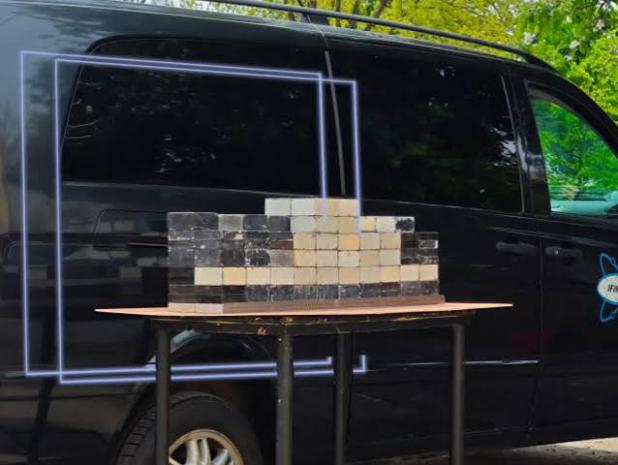
Firing up the world's most powerful laser at Romania's Extreme Light Infrastructure Nuclear Physics (ELI-NP), a team of physicists generated a beam of high-energy particles called muons to image an object through meters of concrete.
As grainy and lacking in detail as they are, the "pictures" – presented in a paper available on the preprint website arXiv – represent a landmark advance in imaging technology that has applications in everything from security to mining.
Muons are electrons on steroids. These heavyweights are commonly generated when high-speed protons zoom through space and smash into atoms in our upper atmosphere, forcing them to cough up pairs of quarks called pions.
Pions quickly decay into muons, which themselves exist for a blink before decaying into their lighter-mass cousin (and some neutrinos).
Though their lives are short, muons that rain down from above survive just long enough to reach the surface. Thanks largely to their beefy mass, they easily pierce the ground, slipping through dense layers of rock and penetrating far deeper than even the most powerful of X-rays.
Archeologists and engineers have exploited these cosmic showers for decades, using muon-shine to search for signs of hollows within pyramids or mineral deposits deep underground.
Anyone who needs a muograph in a hurry or needs side-on images is out of luck. Muons strike the surface at a rather limited range of angles at a paltry rate of around one every square centimeter per second.
One way to artificially generate muons over practical distances is to use powerful lasers to rapidly accelerate electrons on waves of electromagnetism and smash them into a wall.
Last year, physicists in China, the US, and the UK used surfing electrons to produce muons, proving the technology was feasible.
Another international collaboration led by researchers from Lawrence Livermore National Laboratory and Colorado State University used the same method to create a flash of particles that imaged lead weights inside a truck. Just how many of those particles were muons isn't clear, leaving the official "first pics" open to some debate.
The ELI-NP's 10 petawatt laser is no flashlight. For a brief moment, its beam contains thousands of times the power of every power grid on the planet. That flash whips electrons along on waves until they collide with a lead barricade.