










Breaking News
 This is the future we shall bring into being
 Elon Musk's Vision For The Future Looks Like A Movie
 Phosphorus Munitions Fired by Israel Burn Groves, Orchards in Southern Lebanon
 Iran's IRGC Warns It Will Expand 'Geography of the War' If the US Attacks Again
Top Tech News
 BEYOND THE MOON: NASA plans a nuclear-powered fleet to push DEEPER into space
 Big Oil Backs Mazama's $135 Million Bet On Superhot Geothermal
 Quantum compass takes flight on Northrop's Lumberjack drone
 Terrifying AI Behavior Even Its Creators Couldn't Explain
 WW3 Near-Miss? AI Hallucinated Nuclear Weapons Components Aboard Chinese Vessel Bound For Iran
 Stripe Is Building the Toll Road for the Machine Economy
 Toyota Dakar hopeful swaps twin-turbo V6 for hydrogen fuel cells
 4-min turbo-inflatable cubic camp castle is now available in the USA
 Researchers Used Claude To Hack OpenAI Employee Accounts
 Chinese Scientists Develop New Oil Refining Method That Cuts Energy Use by 90%



Solar Impulse Just Completed Its Momentous Flight Around the World
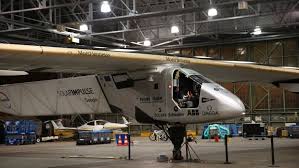
Sun haters, to the left. Solar Impulse 2 touched down in Abu Dhabi today, becoming the first fuel-free plane to successfully circumnavigate the globe. OK, so the 22,000-mile trip took a minute: The solar-powered bird lifted off from the same city in March 2015. But despite a few setbacks, the plane and Swiss pilot Bertrand Piccard (who took shifts with fellow flyer André Borschberg) touched down without incident.
Solar Impulse 2 is a seriously nifty machine. Its 236-foot wingspan makes it wider than a Boeing 747, but the thing is just 5,000 pounds. 17,000 rigid, photovoltaic panels charge four uber-efficient batteries, which make up nearly a third of the weight. Its four 17.4-horsepower motors definitely aren't the fastest: The plane tops out around 90 mph, and traveled at an average of 38 mph across the Pacific. (Yeah, we'd honk at it on the highway, too.)
But the slow speed didn't seem to bother Piccard and Borchberg, who used yoga, meditation, and breathing exercises to get through day-long stretches in the plane's coffin-like cockpit. Making history also seems to be worth sleeping in 20-minute spells—the pilots did that, too.
At a few points in the 17-leg journey, though, it sure looked like Solar Impulse 2 wouldn't make it. The pilots faced ugly weather over the Pacific—storms are particularly bad news for a sun-powered plane. Then the Pacific leg also fried the plane's batteries, leading to a nine-month delay. But the team sure made the best of that, raising an extra $20 million from sponsors and adding a battery cooling system. Then in May, another boo-boo: A power outage in Dayton, Ohio, deflated the plane's bespoke hangar and slightly damaged the plane. In mid-July, Piccard's upset stomach delayed the final leg between Cairo, Egypt, and Abu Dhabi. And in a final twist of irony, the sun tried sabotaging the mission. Super-hot temperatures (like, 119 degrees Fahrenheit hot) over the Saudi Arabian desert postponed the trip once again.