










Breaking News
 This is the future we shall bring into being
 Elon Musk's Vision For The Future Looks Like A Movie
 Phosphorus Munitions Fired by Israel Burn Groves, Orchards in Southern Lebanon
 Iran's IRGC Warns It Will Expand 'Geography of the War' If the US Attacks Again
Top Tech News
 BEYOND THE MOON: NASA plans a nuclear-powered fleet to push DEEPER into space
 Big Oil Backs Mazama's $135 Million Bet On Superhot Geothermal
 Quantum compass takes flight on Northrop's Lumberjack drone
 Terrifying AI Behavior Even Its Creators Couldn't Explain
 WW3 Near-Miss? AI Hallucinated Nuclear Weapons Components Aboard Chinese Vessel Bound For Iran
 Stripe Is Building the Toll Road for the Machine Economy
 Toyota Dakar hopeful swaps twin-turbo V6 for hydrogen fuel cells
 4-min turbo-inflatable cubic camp castle is now available in the USA
 Researchers Used Claude To Hack OpenAI Employee Accounts
 Chinese Scientists Develop New Oil Refining Method That Cuts Energy Use by 90%



Meet the Self-Driving Car Built for Human-Free Racing
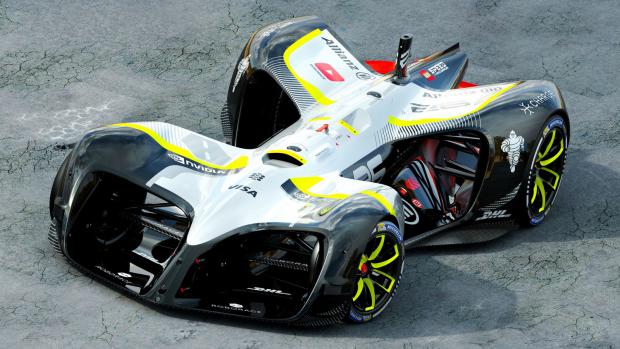
Foldaway steering wheels. Spinning seats. Screens everywhere you look. After all, things get wild when the human inside doesn't have to drive, or even look at the road, anymore. But when you take the human out of the car altogether, the design department can fully let loose.
"We want people to see this like a Tron, or an Oblivion, or a Star Wars spaceship," says Justin Cooke, chief marketing officer of Roborace.
Roborace, if you haven't figured it out, is the company starting the world's first motorsports serious for driverless cars. And today at Mobile World Congress in Barcelona, it showed off its star vehicle, which looks like it comes straight off the set of a high-budget sci-fi flick. The real-life, race-ready robocar resembles a crouching insect, ready to leap. The center of the body is just a narrow spine (no cockpit) and the four wheels (some things don't change) are tucked inside huge aerodynamic scoops.