










Breaking News
 This is the future we shall bring into being
 Elon Musk's Vision For The Future Looks Like A Movie
 Phosphorus Munitions Fired by Israel Burn Groves, Orchards in Southern Lebanon
 Iran's IRGC Warns It Will Expand 'Geography of the War' If the US Attacks Again
Top Tech News
 BEYOND THE MOON: NASA plans a nuclear-powered fleet to push DEEPER into space
 Big Oil Backs Mazama's $135 Million Bet On Superhot Geothermal
 Quantum compass takes flight on Northrop's Lumberjack drone
 Terrifying AI Behavior Even Its Creators Couldn't Explain
 WW3 Near-Miss? AI Hallucinated Nuclear Weapons Components Aboard Chinese Vessel Bound For Iran
 Stripe Is Building the Toll Road for the Machine Economy
 Toyota Dakar hopeful swaps twin-turbo V6 for hydrogen fuel cells
 4-min turbo-inflatable cubic camp castle is now available in the USA
 Researchers Used Claude To Hack OpenAI Employee Accounts
 Chinese Scientists Develop New Oil Refining Method That Cuts Energy Use by 90%



Burn Patients Are Healing Faster With Less Pain Thanks To Fish "Gauze"
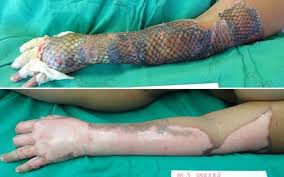

Credit: Stat News
In some developing countries, the skin of animals has often been used on patients with severe burns because they lack the skin resources that are more widely available in developed nations, like the U.S. In Brazil, there are a mere 3 functional skin banks in the entire country, which meet only 1 percent of the demand for skin for burn victims.
Typically, human skin, pig skin, and artificial alternatives are used in the treatment for victims, but with so few resources in Brazil, doctors have been forced to go with the more painful approach, instead using cream and gauze on the wounds. With this method, the gauze must be unwrapped and changed every single day, which is extremely painful for the patients, who are often seen writhing and screaming in pain.
What's worse is that the cream and gauze only help keep the wound clean; Dr. Jeanne Lee, interim burn director at the the regional burn center at the University of California at San Diego, said that this method doesn't necessarily help the burns in the healing process nor does it remove nonliving tissue from the wound like skin alternatives do. It's the only option that they've had—until now.

Credit: Stat News