










Breaking News
 Amazon Boeing Plane Bursts Into Flames After it Overshoots Runway at Miami International Airpot
 Trump grants clemency to 30 people, White House pardon czar says
 Bessent: "CUT THE SNAKE'S HEAD OFF"--But Who is the Real Target?
 Special LIVE Saturday Show: Could The Gov Seize XRP After Chilling FDIC Admission? Gas Prices...
Top Tech News
 Floating data center would provide water and electricity to 32,000 homes
 OpenAI Cuts Off Elon's Cursor, Humanity's First Star Probe, and Trump's Nuclear Mars Shi
 Eating pollution? Plastic-to-cookie technology raises safety, environmental concerns
 Ford's $30,000 Fathom EV Truck Appears More Conventional Than Expected
 Berlin-based artist Simon Weckert explored that idea with Digital Camouflage...
 Tether expands tokenization business into Saudi Arabia, starting with real estate
 Ukraine is facing a new problem in its war with Russia:
 It charges more than it discharges while driving
 Dataminr AI tech to go live on NATO Maven system: CEO
  The Most Dangerous Interview Ever Recorded? PART 2


Is it a bird? Is it a plane? Flying car to go on sale
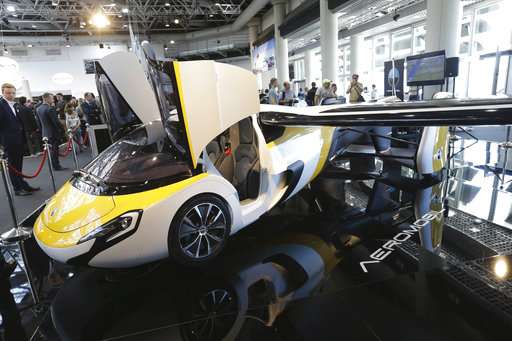
A Slovakian company called AeroMobil unveiled on Thursday its version of a flying car, a light-framed plane whose wings can fold back, like an insect, and is boosted by a hybrid engine and rear propeller.
It will be available to preorder as soon as this year but is not for everyone: besides the big price tag—between 1.2 million and 1.5 million euros ($1.3 million-$1.6 million)—you'd need a pilot's license to use it in the air.
"I think it's going to be a very niche product," said Philip Mawby, professor of electronic engineering and head of research at the University of Warwick.
Several companies are working on flying cars, either like Aeromobil's two-seater that needs a runway, or others that function more like helicopters, lifting off vertically. But not many companies are seriously looking at marketing these vehicles anytime soon, Mawby said.