










Breaking News
 This is the future we shall bring into being
 Elon Musk's Vision For The Future Looks Like A Movie
 Phosphorus Munitions Fired by Israel Burn Groves, Orchards in Southern Lebanon
 Iran's IRGC Warns It Will Expand 'Geography of the War' If the US Attacks Again
Top Tech News
 BEYOND THE MOON: NASA plans a nuclear-powered fleet to push DEEPER into space
 Big Oil Backs Mazama's $135 Million Bet On Superhot Geothermal
 Quantum compass takes flight on Northrop's Lumberjack drone
 Terrifying AI Behavior Even Its Creators Couldn't Explain
 WW3 Near-Miss? AI Hallucinated Nuclear Weapons Components Aboard Chinese Vessel Bound For Iran
 Stripe Is Building the Toll Road for the Machine Economy
 Toyota Dakar hopeful swaps twin-turbo V6 for hydrogen fuel cells
 4-min turbo-inflatable cubic camp castle is now available in the USA
 Researchers Used Claude To Hack OpenAI Employee Accounts
 Chinese Scientists Develop New Oil Refining Method That Cuts Energy Use by 90%



MIT Has Developed Colour-Changing Tattoo Ink That Monitors Your Health in Real Time
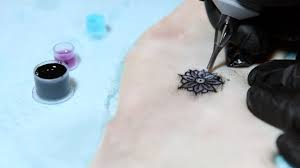
Researchers have developed a new colour-changing tattoo ink that responds to changes in the body, such as blood sugar and sodium levels.
Using a liquid with biosensors instead of traditional ink, scientists want to turn the surface of the human skin into an "interactive display" - an idea that makes this proof-of-concept an exciting one to watch. Technology like this could become a revolutionary new way to monitor health.
The project, called DermalAbyss, is a collaboration between researchers from MIT and Harvard Medical School, combining efforts from Fluid Interfaces and biotechnology.
So far, the team has developed three different inks that shift colour in response to changes in interstitial fluid - the stuff that sloshes around between our cells, comprising some 16 percent of the human body weight.